
How HDR Works
Increasing dynamic range increases the perception of resolution. Our eyes will perceive an image as clearer if the colors on the image have greater contrast, far more than they can perceive an increase in pixels. In fact, to actually perceive the improved resolution of 4k Ultra-HD (UHD), you must view the screen from a distance of 1.5 screen heights, or the perceived resolution will degrade. With increased dynamic range, however, you can perceive the clarity from a distance, much the same way that you might be able to see a candle on the other side of a dark field. Our eyes are wired to see these contrasts and are far better at perceiving the differences between dark shades, than between bright ones.

HDR Technology
HDR is actually three advanced image technologies: Wide Color Gamut (WCG), higher sample precision, and the HDR transfer function.
Wide Color Gamut (WCG)
The human eye can perceive a wide range of colors, but the screens we use are limited as to what they can display. The color gamut in the image below shows the colors a human eye can see and the colors different screens can display. The inner triangle shows the colors that an HDTV is capable of displaying, and the outer triangle shows what UHDTV can display.
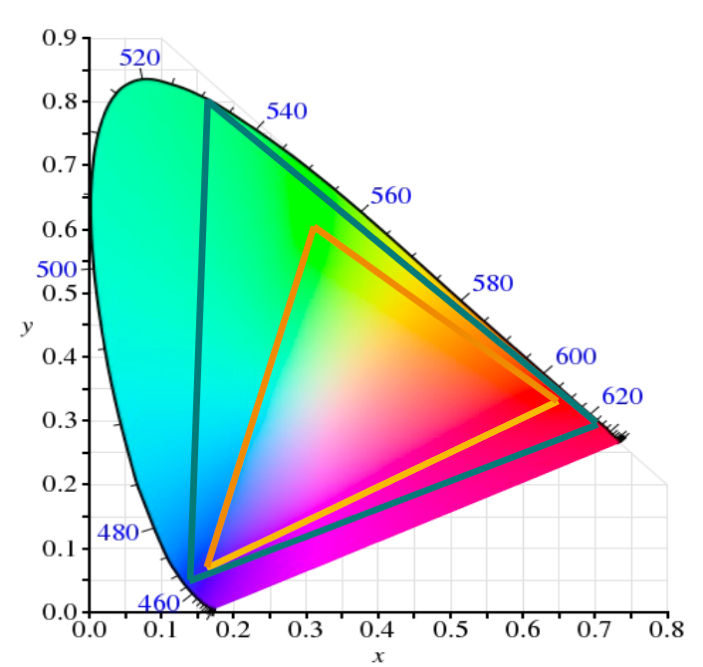
Screens essentially approximate the color you would see naturally. The green of highway signs is an example of a color that cannot be precisely represented on screen. You wouldn’t notice anything unusual about a highway sign on a TV show, but if you were to hold the image up next to a sign in real life you could quickly see it was a different color. HDR uses a Wide Color Gamut, in that it is able to show a wider range of colors than HDTV can, and therefore more accurately represent on screen what a scene would look like in person.
Color Volumes
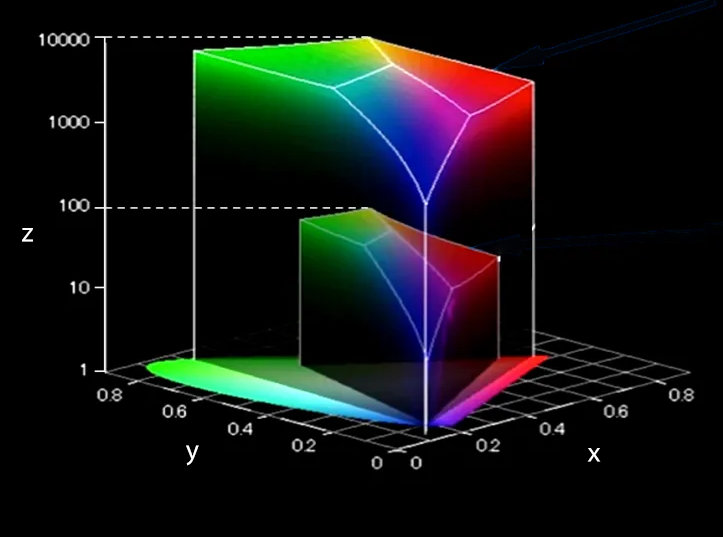
The light we see is both a specific color, and a level of brightness (luminosity). Two colors can be identical, but we see them differently because one is “lighter” or “darker” than the other. The difference between the brightest and the darkest areas of the image is its Dynamic Range. It is important to remember that dynamic range isn’t about the absolute brightness of your TV screen overall, but rather the difference between the brightest and darkest areas. The average light level on the screen doesn’t increase with a higher dynamic range, however you can discern the subtle shading in the dark areas, while simultaneously perceiving much brighter specular highlights on a screen with a higher dynamic range.
Dynamic range is measured in nits and is shown in the image below on the z-axis, while the colors they represent are on the x and y-axis. The image below shows both the HDR and SDR (Standard Dynamic Range) Color Volumes. This shows the range of colors that a tv screen can represent, but also includes the amount of Dynamic Range each color can produce.
Higher Sample Precision
Most digital TVs uses 8-bit sampling which can cause color banding, or “contouring lines”, on images that gradually fade. This is due to the color of each pixel being rounded to the nearest digital color level, creating the bands of color you see on the left of the below image, as opposed to the fade you see on the right. HDR and WCG exacerbate this issue.
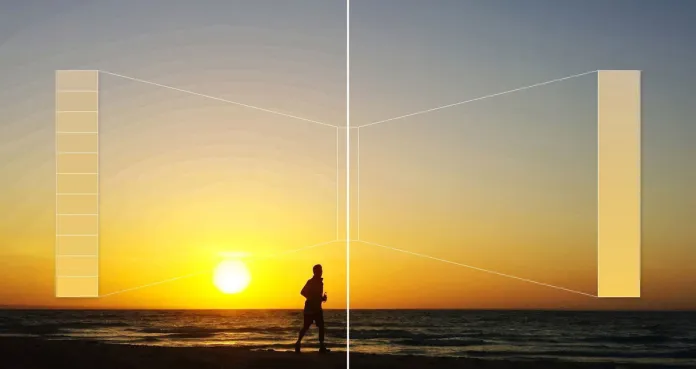
HDR uses 10-bit sampling which significantly improves the picture quality without increasing the amount of bandwidth used due to how video compression works.
Transfer Function
A camera captures light from a scene and turns it into a digital signal. The digital signal is transmitted to a TV, and the TV turns the digital signal back to light, so the audience sees the scene. To do this, a display uses a transfer function.
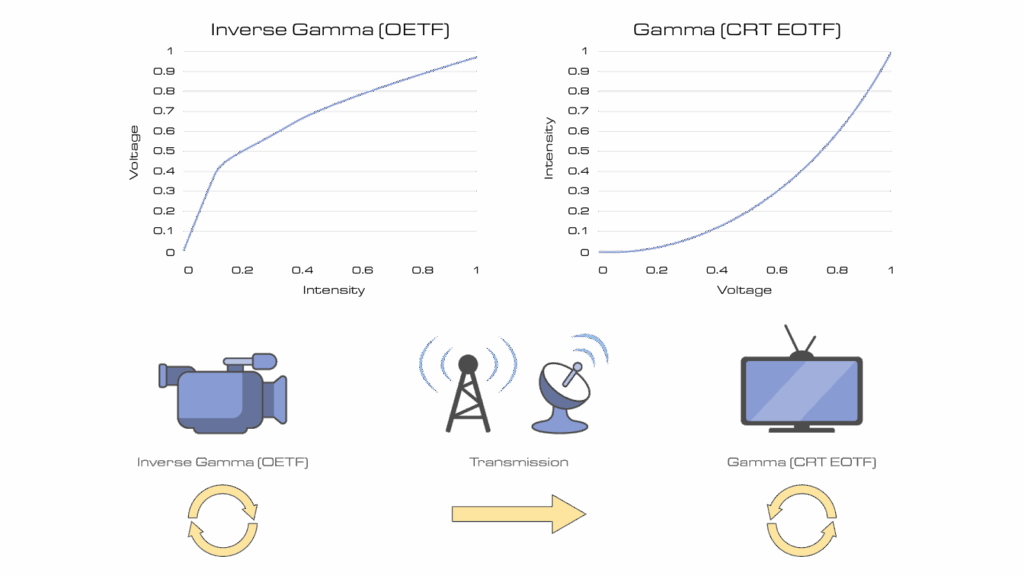
A transfer function defines how dynamic range is encoded and decoded in a signal. OETF (Opto-Electronic Transfer Function) is used in cameras to convert visible light into a digital signal. EOTF (Electro-Optical Transfer Function) is used by a TV screen to convert the incoming digital signal back into light. Specifically, they are mathematical curves that define how luminance is mapped from the digital inputs to the dynamic range capabilities of the display to accurately depict the image.
Cathode Ray Tube (CRT) TVs were the standard for approximately seventy years, but the brightest a CRT screen could display was 100 nits (what we now call Standard Dynamic Range). The HVS can discern far more dynamic range than a CRT is capable of displaying, and with new HDR TVs we can finally achieve more realistic images on TV.
Since the human visual system (HVS) is much more sensitive to slight changes in the luminance of dark areas than it is to wide changes in the luminous for bright specular highlights, a specially crafted modified logarithmic scale (matching the HVS sensitivity to light) is used to represent the values of the HDR transfer function. A logarithmic scale allows more values to be used for lower light levels, and fewer for higher light levels to match the HVS.
The ITU defines two different HDR transfer functions: Perceptual Quantization, and Hybrid Log Gamma.
Perceptual Quantizer
Perceptual Quantizer (PQ) is an HDR transfer function that encodes absolute brightness values to match how the human eye perceives light. It allocates more digital steps to darker tones, where our eyes are more sensitive to differences, and fewer to bright areas, where our eyes are less sensitive. This allows more precise shadow detail while preserving highlights. PQ delivers a precise, reference-quality image, but requires metadata and displays capable of interpreting those absolute brightness levels. HDR10, the most common HDR format in the market, uses PQ.
Hybrid Log-Gamma (HLG)
Unlike Perceptual Quantizer, which encodes absolute brightness, HLG uses a relative curve that adapts to each display’s own brightness range. It combines the traditional gamma curve of SDR with a logarithmic curve to account for highlights. HLG does not require metadata, therefore it is easier to use for live production.
PQ and HLG operate differently and are not seamlessly interoperable at the display. Each of them must be normalized before converting to the other.
Static vs. Dynamic HDR
Some HDR formats include static or dynamic metadata to aid the receiver in understanding the color volume. The table below gives a quick explanation.
| Feature | Static Metadata | Dynamic Metadata |
| Adjustment Type | One-time, applies to the whole video | Adjusts for each scene or frame |
| Flexibility | Limited – doesn’t adapt to changing contrast of the content | Adapts scene-by-scene |
| Example Metadata | MaxCLL (Maximum Content Light Level), MaxFALL (Maximum Frame-Average Light Level) | Scene-by-scene tone mapping, color grading adjustments |
| Supported Formats | HDR10 | Dolby Vision, HDR10+, Advanced HDR by Technicolor (SL-HDR1/2/3) |
| Best Use Case | Basic HDR content (streaming, Blu-ray) | High-quality HDR (streaming, premium content) |
Advanced HDR by Technicolor (AHDR)
Broadcasters want to support a compelling HDR experience to capable devices but face some challenges. Bandwidth constraints can make broadcasting in UHD a challenge, particularly as multiple formats exist with different requirements. Broadcasters must also ensure they continue to serve legacy SDR viewers, so must find a way to deliver both formats over a limited pipe.
Sinclair has opted to use AHDR . AHDR is not just another HDR format, but a carriage mechanism of HDR10 or HLG with dynamic image improvement. It produces a single stream of bandwidth efficient video that is broadcast to all receivers, but contains HDR metadata allowing new HDR displays to see the best visual experience, which ensuring SDR viewers are not left in the cold.
In AHDR, a camera captures HDR content and down converts it to SDR, while capturing the HDR information as metadata. The content is then sent through the broadcast chain as SDR, enabling low bit usage and backwards compatibility with SDR televisions. HDR televisions can use the encoded HDR metadata to reconstruct the HDR content.
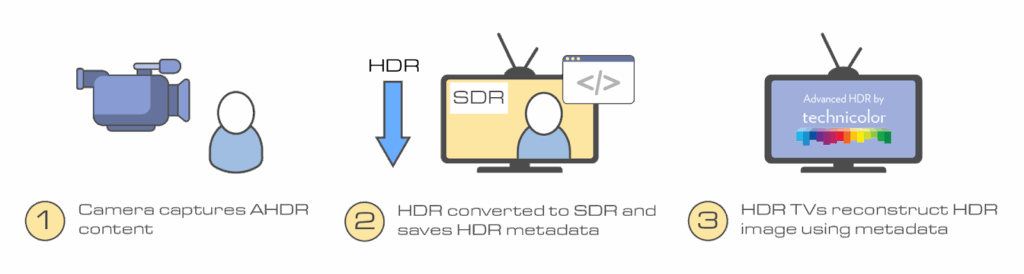
This means the content can be used by live broadcasts, unlike Dolby Vision which is limited to pre-produced content. It uses a PQ Transfer function, and the tone mapping is dynamic and adjusts the content per frame. Its metadata is dynamic with AI-based conversion, ensuring the best possible picture is seen on screen in each scene, while maintaining backwards compatibility.
Key Features
- Real-time dynamic tone mapping, ideal for live TV and sports
- SDR-to-HDR conversion using AI, so broadcasters can deliver one SDR signal with HDR metadata
- Works across multiple display types without requiring separate HDR/SDR versions
- Doesn’t need pre-encoded metadata—adapts on-the-fly based on content analysis
See the World as it Is
HDR expands the visual range of content in a way that aligns with how our eyes see the world. By increasing dynamic range, leveraging a wider color gamut, using higher precision sampling, and employing advanced transfer functions, HDR delivers deeper detail in shadows, more nuance in highlights, and overall greater image clarity than traditional video formats can achieve.
Understanding how these elements work together helps demystify why HDR looks so compelling on modern displays and why it’s become an essential part of high-quality video production and viewing.