
ATSC3.0 Bridge Architecture Explained
M. Myslinski, R. Kamran & Joe Fabiano
October 2025
Abstract: This paper aims to present a high-level overview and conceptual evolution of the ATSC 3.0 Bridging (BR) architecture, positioning it as a transitional framework bridging ATSC 3.0 legacy systems and emerging B2X systems.
Rationale behind ATSC3 Bridging architecture
The demand for multicast broadcasting services continues to grow, driven by high-traffic scenarios such as live events, large-scale file delivery, software distribution and updates, and regional emergency alerts. Simultaneously, the industry is witnessing a paradigm shift toward streaming and on-demand multimedia consumption, prompting the need to evolve traditional broadcast networks into more capable, feature-rich platforms. To address these emerging requirements, we initiated the development of a new Radio Access Network (RAN) architecture known as Broadcast-to-Everything (B2X). This design aligns with the user plane specifications of mobile networks, enabling greater flexibility for convergence scenarios. The overarching goal of B2X is to support a diverse range of advanced services and accommodate various types of next-generation devices capable of handling B2X traffic. However, as B2X evolves to support new services and convergence use cases, it diverges from the architecture of the currently deployed ATSC 3.0 transmission chain. Ensuring backward compatibility remains a critical consideration in any network evolution. To bridge this gap, we have proposed a transitional architecture named as ATSC 3.0 Bridging (BR) architecture that enables interoperability with existing ATSC 3.0 systems while offering limited support for select advanced services of B2X. This bridging solution also acknowledges and addresses the inherent limitations of legacy systems, paving a pragmatic path toward future-ready broadcast infrastructure.
A Single solution: Joint architecture
The Bridge Architecture and B2X Architecture share joint architectural elements including a common Broadcast Core Network as shown in Figure 1. The joint architecture is a single root architecture considering common B2X and ATSC3-BR features. Where it establishes common approach, building blocks, modular approach, and generic IP Network Interwork. It also leverages the external Generic IP Network path for 2-way IP communication. As terrestrial broadcasting services are migrating towards an IP-based multicast delivery, there are still components of the existing ATSC 3.0 architecture unaware of the IP‑based evolution for multicasting. Therefore, an element is needed to fill this gap enabling broadcast services in an IP-based connected world. The missing piece to bring the broadcast infrastructure to the IP-connected world is the Broadcast Core Network (BCN).
The goal of the BCN is to connect all broadcast facilities (contribution, production, distribution, archive, cloud, and tower networks) to make the broadcast industry part of the connected world. BCN also enables broadcasters to introduce new IP multicast services (which may require two way communication with BEs) as well as internetworking with other communication networks and systems. BCN functionalities can be same as some existing functionalities of ATSC 3.0 transmission chain and new functionalities need to be evolved based on the requirements for convergence. As previous release BCN was not formally included and functionalities were not architected to connect to the internet and did not allow off-the-shelf Applications and Services to operate over ATSC connectivity. The new BCN will provide certain authentication and authorization services along with connecting the edge devices to the internet and cloud-based application servers for serving-up User Plane data flows via ATSC B2X bandwidth.
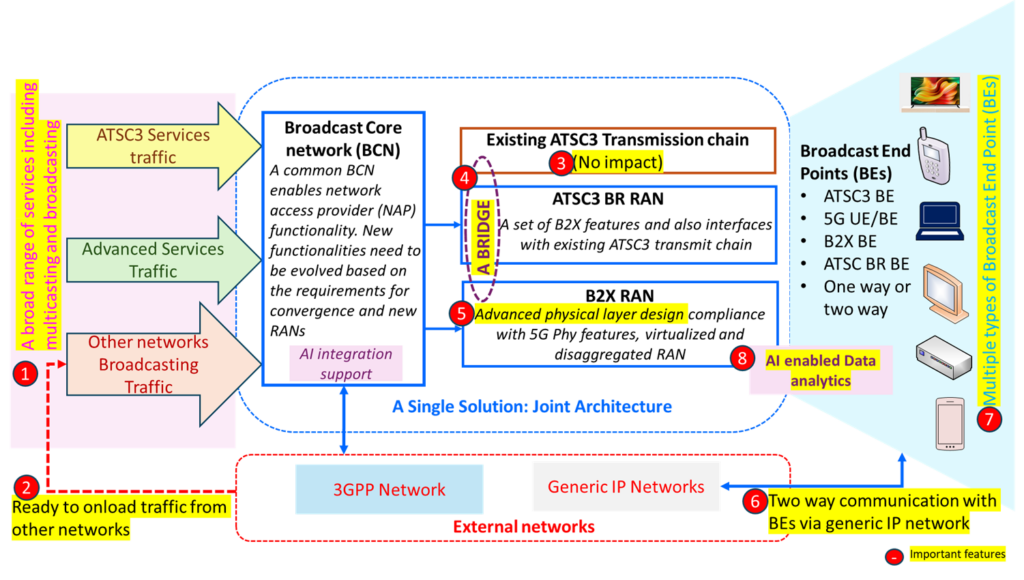
Figure 1: A single solution: Joint architecture
Overall, the joint architecture approach offers the following key benefits, as illustrated in the accompanying figure:
1. Comprehensive Service Support: Enables delivery of both legacy broadcast services and advanced IP-based applications including multicasting and broadcasting both.
2. Traffic Onloading Capability: Designed to seamlessly absorb traffic from external networks, including 3GPP systems.
3. Preservation of Existing Infrastructure: Ensures zero disruption to the current transmission chain and ongoing service operations.
4. BR Subsystem Integration: Introduces a bridging module between B2X and ATSC 3.0 to facilitate interoperability.
5. Modernized PHY/L1/L2 Stack: Incorporates next-generation physical and link layers aligned with mobile network standards, supporting cloud-native, virtualized, and disaggregated RAN deployments.
6. IP-Centric System Architecture: Built on standards-based IP routing, enabling bidirectional communication with Broadcast End points (BEs) over generic IP networks and supporting integration with one or more interworking domains (e.g., 3GPP, generic IP).
7. Versatile Endpoint Compatibility: Capable of serving a wide range of broadcast endpoints legacy or advanced across both one-way and two-way communication modes.
8. AI integration support: The new functionalities in BCN and advanced RAN design enable integration of AI capabilities across multiple architectural stages.
ATSC-BR system: a step towards the B2X
ATSC-BR is an ideal intermediate step between ATSC 3.0 and B2X. It does not provide all B2X features, but it enables support for Advanced Services and other important capabilities such as IP multicast and early experiments with hybrid broadcast-broadband delivery. By doing so, it allows broadcasters to bridge the gap between current broadcast systems and the full B2X platform.
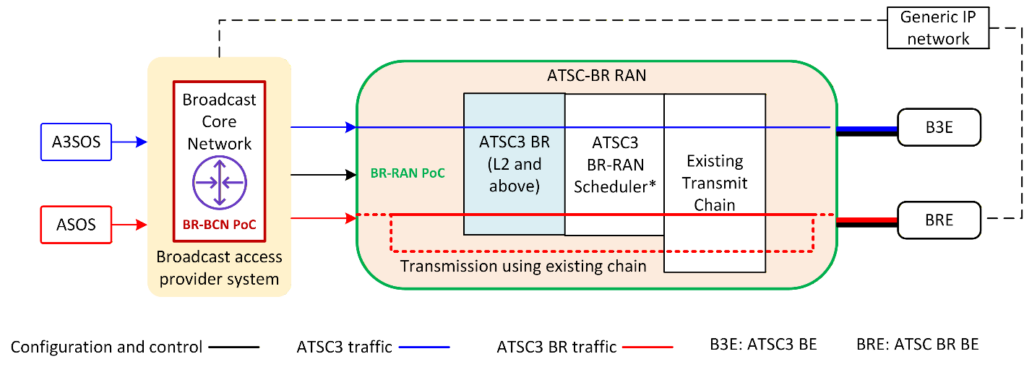
Figure 2: ATSC3 BR System
Figure 2 shows high level architecture for ATSC3-BR system. Viewed at a high level, the ATSC 3-BR system is composed of at least 2 key functions: Broadcast Core Network and RAN. The ATSC 3-BR system is designed to offer as many B2X RAN features as possible to new BRE endpoints (ATSC 3-BR endpoints) while ensuring no impact to existing B3E endpoints (ATSC 3 endpoints). Beyond the RAN, both ATSC3-BR and B2X systems share a Joint Architecture providing a common BCN (Broadcast Core Network) between the systems. This commonality allows ASOS (Advanced Service Operator Systems) to run against either a BR or B2X system. The ATSC3 BR-RAN needs to be compatible with existing ATSC3 on site transmission chains while supporting existing ATSC3 PHY/L1/L2 messaging and potentially modified ATSC3-BR PHY/L1/L2 messaging. The set of B2X-like RAN features moved into the ATSC 3-BR RAN will require a detailed study to determine which can be supported while not impacting A3E endpoints. It is expected that the modifications to the ATSC 3.0 PHY, Layer 1, and Layer 2 components will be minimal modifications.
The Joint Architecture’s Broadcast Core Network enables network access provider (NAP) functionality. Appropriate traffic will be provided to a BR-RAN to be available to BREs (ATSC3-BR Endpoints). The BCN also performs key functions such as traffic admission, billing enablement, QoS, and bandwidth reservation. IP Multicast traffic is directed to one or more Broadcast Downstream Links (BDLs), which are an abstraction of a specific RAN’s antenna. The shared BCN provides an interface for Advanced Service Operator Systems, allowing a service operator to have IP multicast traffic arrive at BRE endpoints. Through this interface, an ASOS will describe a multicast to the BCN (via source specific multicast identifiers), request various operational attributes, and request the IP multicast be admitted to the BCN. After this session establishment is complete, ASOS IP multicast traffic will be routed through the BCN to BRE endpoints by the BCN’s SDN functionality (as appropriate).
ASOS are external services outside the BCN which provide IP multicast traffic to BEs and interface with BCN to fulfill the requirements of the the services. A BE (Broadcast Endpoint) is an entity with no required physical embodiment that can receive broadcast data. A BE is the root of a hierarchy of endpoints, which includes child endpoints such as ATSC 3 (B3E) endpoints and ATSC 3-BR (BRE) endpoints. There shall be different kinds of BEs receiving unique traffic. A3Es will receive ATSC3 traffic that is independent from the ATSC3-BR traffic and BRE’s will receive IP Multicast. Generic IP module is included to leverage an external Generic IP Network interwork path for 2-way IP communication with BEs or other IP enabled systems or services. Variations on the Generic IP network can exist, such as interworking with 3GPP.
What’s next for ATSC3 BR system
ATSC standardization: S44 serves as the specialist group responsible for advancing B2X-related initiatives within ATSC. Supporting this effort are several ad hoc subgroups, each focused on specific domains: S44-1 for Joint Systems; S44-2 for B2X RAN Systems; S44-3 for B2X Systems; S44-4 for BR Systems and S44-5 for Security. These teams are poised to initiate documentation and technical analysis activities, working collaboratively to build consensus across participating companies and stakeholders. Notably, S44-4 is dedicated to the BR system, with a focus on defining architectural components and their functional roles in managing traffic from ATSC 3.0 and BR ASOSs.
The Proof of Concept (PoCs) planned: The PoCs for the ATSC 3.0 BR system is being prioritized and will proceed through two parallel tracks: the BR-RAN PoC and the BR-BCN PoC. The BR-RAN PoC focuses on solutioning, documentation, demonstration, and validation of the ATSC-BR Radio Access Network (RAN) architecture and interface design. In parallel, the BR-BCN PoC aims to create and demonstrate a Broadcast Core Network (BCN) that aligns with the Joint Architecture. As part of the PoC, an Advanced Service Operator System (ASOS) will interface with the BCN, which will ingest multicast IP traffic from ASOS and utilize the PoC-BR RAN to deliver this traffic to BREs. Additionally, the PoC will support ATSC 3.0 traffic delivery through the PoC-BR RAN for distribution to B3Es.
Research Project: A research project is planned to recommend and validate the solution for ATSC3-BR RAN design that supports control signaling required for ATSC3-BR and ATSC3 traffic to transmit through ATSC-BR physical layer without impacting the existing ATSC 3.0 transmit chain functionality. ATSC3-BR RAN design shall support the maximal set of B2X PHY/L1/L2 features while maintaining backward compatibility with ATSC3 endpoints.
Development initiatives: Primary development efforts are focused on implementing core BCN functionalities and a subset of BR-RAN features essential for enabling basic data flow and demonstrating the concept. This foundation will serve as a baseline for future expansion aligned with BR or B2X system requirements.
Conclusion
ATSC 3.0 represents the current broadcast standard, while B2X (Broadcast to Everything) defines the future vision for greenfield applications. Positioned as a strategic bridge, ATSC3-BR (Bridge Architecture) delivers early access to key B2X capabilities by introducing IP network and Advanced Service interfaces ahead of full B2X deployment. ATSC3-BR shares its Broadcast Core Network architecture with B2X and supports IP multicast routing for functions such as offload, onload, repair, and datacasting. Devices built on ATSC3-BR will operate over generic IP networks and maintain compatibility with ATSC3 hardware, though new software will be required to enable BR-specific features. In contrast, B2X introduces a next-generation PHY/L1/L2 stack and is not backward-compatible with ATSC3. It retains the Broadcast Core and multicast routing capabilities of ATSC3-BR, while expanding IP connectivity options through Generic IP networks, Deep 3GPP integration and other infrastructures such as DOCSIS. Together, this phased evolution (from ATSC 3.0 to ATSC3-BR to B2X) ensures a scalable transition path toward advanced broadcast services and seamless IP integration.