
Broadcasting in the Cloud
Cloud-based broadcasting introduces new ways to build and operate our facilities. Compute, storage, and transport can be scaled as needed, services can be launched quickly, and redundancy can be designed into the architecture rather than added as hardware. These capabilities allow broadcast systems to be more flexible, efficient, and consistent across markets.
ATSC 3.0 fits naturally into this model. Its IP-based design allows playout, encoding, packaging, and signaling to remain in a single cloud environment all the way to transmission. This reduces complexity, improves visibility, and enables faster deployment of new services.
This post is based on Jay Willis’ 2025 NAB white paper Beyond the Cloud: Native Broadcasting with ATSC 3.0, that proposes a unified approach to cloud based broadcasting, and examines how ATSC 3.0 can support a fully integrated broadcast infrastructure.
Why ATSC 3.0 Changes the Equation
ATSC 1.0 was never designed for flexibility. MPEG-2, fixed bitrates, and 8-VSB did their job well for decades, but they locked broadcasters into a rigid model. You built an air chain, you sized it for peak, and you hoped nothing broke. Multipath was an enemy. Transport was fragile. Any deviation from the norm usually meant a truck roll.
ATSC 3.0 lets broadcast behave like a cloud workload.
ATSC 3.0 flips that model on its head. At its core, it is an IP system. Video, audio, captions, signaling, and even physical layer parameters are all managed as data. OFDM turns multipath from a liability into a feature. Bitrates and robustness are no longer hardwired. Services can be created, modified, or removed without forcing viewers to rescan.
From a cloud perspective, this matters because ATSC 3.0 allows broadcasters to speak the same language as modern compute infrastructure. DASH segments, IP multicast, web-style signaling, and software-defined processing fit naturally into virtualized environments. Instead of adapting cloud tools to broadcast, ATSC 3.0 lets broadcast behave like a cloud workload.
Cloud Playout as the Foundation
Most broadcasters start their cloud journey with playout. File-based workflows move ingest, transcode, and playlist execution into centralized infrastructure and eliminates duplicated effort.
Instead of every station receiving the same show, transcoding it locally, and manually prepping it for air, the content is processed once and made available everywhere. Quality becomes consistent by design, not by best effort. Visibility improves because every stream is observable in one place. Redundancy stops being a rack of spare gear and starts being a regional architecture decision.
Once live feeds are added, cloud playout begins to resemble traditional master control, just without the physical room. News feeds, network feeds, and live events enter the cloud over protected IP links. From there, switching, branding, and automation happen exactly where the file content lives.
Extending the Cloud Into the Air Chain
This is where cloud-native broadcasting stops being a cost optimization exercise and starts becoming an architectural rethink. By keeping the output of master control in the cloud, the ATSC 3.0 air chain can live there as well.
Encoders become elastic compute instances. Additional headroom for a complex UHD service or an extra PLP is handled by resizing the instance. Temporary services for a weekend event can be spun up quickly and torn down just as easily when they are no longer needed. Packagers assemble DASH segments into broadcast services while injecting signaling dynamically. Gateways manage physical layer parameters in software instead of firmware.
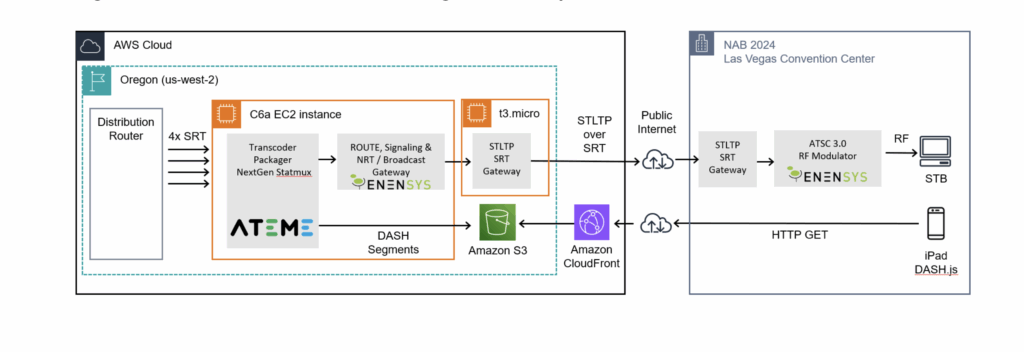
CLOUD BASED ATSC 3.0 AIR CHAIN WORKFLOW
The result is an end-to-end chain that stays in one domain until the very last step, when STLTP leaves the cloud and heads to the transmitter. Encoding, packaging, and signaling happen without unnecessary decode and re-encode cycles. Latency drops. Complexity drops. Change becomes easier.
This approach also aligns with how modern services are deployed and tested. Infrastructure as code replaces racking diagrams. Version control replaces binder documentation. New markets or services no longer require shipping servers and scheduling site access.
Transport Still Matters
Protected IP protocols like SRT, RIST, and Zixi are essential for moving live content reliably into and out of cloud environments. STLTP itself remains UDP-based, so encapsulation and error correction become part of the system design rather than afterthoughts. The key difference now is protections are implemented consistently and monitored centrally, instead of being configured slightly differently at every site.
The cloud does not remove the need for engineering judgment. It just gives engineers better tools and clearer feedback loops.
Reliability and the Hybrid Reality
Hybrid models that combine cloud-based primary chains with on-prem backup paths acknowledge regulatory requirements, operational comfort, and real-world risk. A local standby chain that can take over if connectivity is lost provides confidence without throwing away the benefits of cloud centralization.
What changes is how often that backup is exercised and how much of the day-to-day operation depends on it. In a cloud-first model, the on-prem gear becomes insurance rather than the main event.
What This Means for Broadcast Engineers
Cloud-based broadcasting represents a fundamental improvement in how broadcast systems are built, deployed, and operated. By shifting core functions into cloud infrastructure, broadcasters gain flexibility that simply does not exist in traditional hardware-bound plants.
ATSC 3.0 accelerates these benefits by aligning broadcast workflows with modern IP and software-based systems. Encoding, packaging, signaling, and transport can all live in a unified environment, reducing unnecessary processing steps and improving end-to-end efficiency. Keeping content in the cloud from playout through emission lowers latency, simplifies signal paths, and improves visibility into system health.
Just as importantly, cloud architectures enable consistency at scale. Quality, monitoring, and security policies can be applied uniformly across markets instead of being tuned station by station. Updates and improvements roll out faster, and infrastructure can evolve alongside changing standards without disruptive rebuilds.
Cloud broadcasting is a mature, proven approach that gives broadcasters a more agile, resilient, and future-ready platform. As the industry continues its transition to ATSC 3.0, the cloud provides the foundation needed to move faster, operate smarter, and adapt to whatever comes next.