
Cloud-Based Advanced Emergency Information (AEI) System for ATSC 3.0, MVPDs, and IP Delivery
Jason Kim
Abstract –This paper proposes a cloud-based Advanced Emergency Information (AEI) System designed to enhance public safety by seamlessly integrating alerts from the Integrated Public Alert and Warning System (IPAWS) with service operators. The AEI System captures emergency alerts in real time, processes them within the cloud, and enables synchronized delivery via ATSC 3.0 broadcast, MVPDs, and internet service operators.The proposed AEI System addresses key interoperability challenges across diverse broadcast and service platforms while ensuring efficiency and flexibility in alert dissemination. Built on a robust system architecture, it utilizes real-time alert processing workflows and advanced delivery mechanisms to improve the reliability of emergency communications. This paper examines these components in detail, highlighting the ability of the AEI System to ensure the widespread, synchronized distribution of critical emergency information to diverse audiences across ATSC 3.0 broadcast and modern communication networks.
Introduction
Recent hurricanes and wildfires have emphasized the importance of a timely and reliable emergency alert system. AEI system is a capability within ATSC 3.0 for transmitting urgent notices related to emergency information [1]. Broadcasters have long been at the forefront of delivering emergency information, but new broadcast technology, the widespread adoption of the internet, and the growth of IP-based services have reshaped the landscape of emergency communication. To keep pace with these developments, a more versatile and interoperable emergency communication system is essential.
The proposed Advanced Emergency Information (AEI) System addresses this need by integrating cloud computing with the ATSC 3.0 standard and IP networks. The System bridges the gap between traditional broadcast methods and modern IP-based delivery platforms, ensuring timely, reliable, and efficient delivery of emergency alerts. This paper focuses on the System’s architecture, real-time alert processing workflow, and multi-platform delivery mechanisms.
Challenge
Traditional Emergency Alert System (EAS) and Wireless Emergency Alerts (WEA) encounter significant difficulties disseminating effective emergency alerts. EAS relies heavily on radio and television broadcasts, which only reach individuals who are actively engaged [2]. Additionally, as audiences increasingly shift toward mobile devices and IP-based platforms, the declining reach of traditional broadcasting is making it harder to connect with mobile-first users.
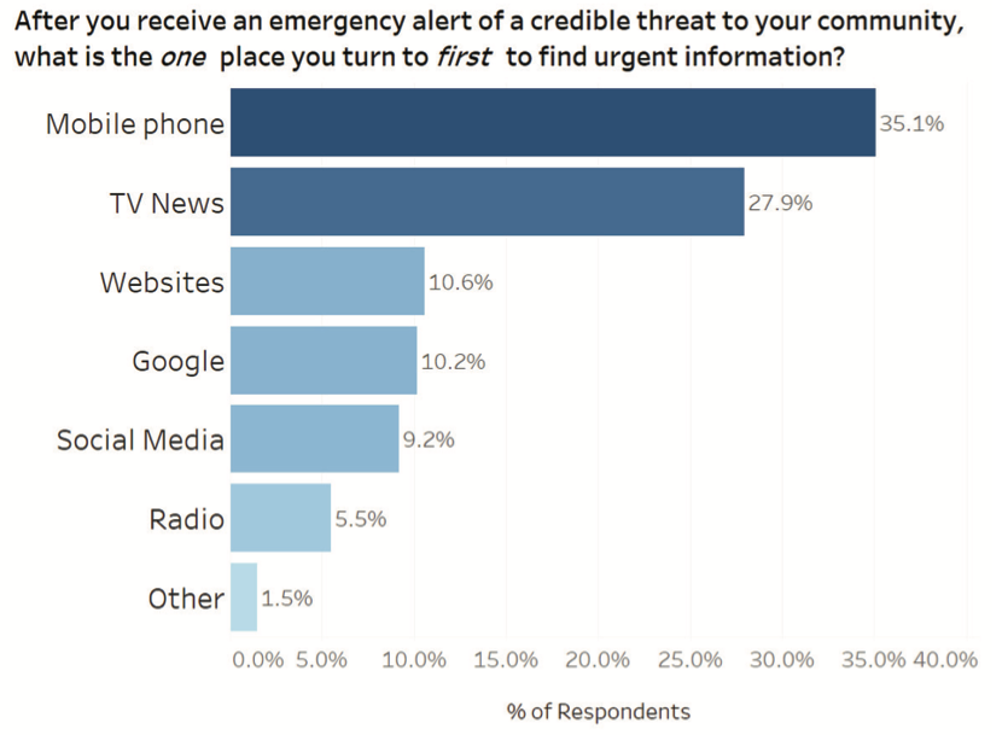
WEAs, on the other hand, struggle with limited message lengths, accessibility challenges, and inaccuracies in geographic targeting [4]. This results in alerts being sent to unintended areas or failing to reach those who need them most. For example, the entire city of Los Angeles recently received an evacuation warning due to the wildfires, despite only being intended for the residents of a single neighborhood [5]. A significant portion of the population also opts out of notifications, further reducing their effectiveness. Furthermore, WEAs rely on mobile and internet networks, which may delay or even fail to deliver essential alerts under heavy network loads.
A lack of synchronization across multiple platforms further compounds these issues. Traditional broadcast systems often operate independently of contemporary platforms like news websites, social media, and mobile apps, resulting in fragmented and inconsistent messaging. Moreover, EAS and WEA are unable to receive real-time updates, integrate with modern technologies, or provide two-way communication, further impeding their ability to adapt to rapidly evolving emergency situations.
Finally, outdated infrastructure and limited support for enhanced alert content, such as multimedia or interactive instructions, hinder public understanding and responsiveness during crises. Addressing these challenges requires adopting advanced technologies to modernize emergency communication systems that are adaptable to diverse audiences and evolving situations.
System Architecture
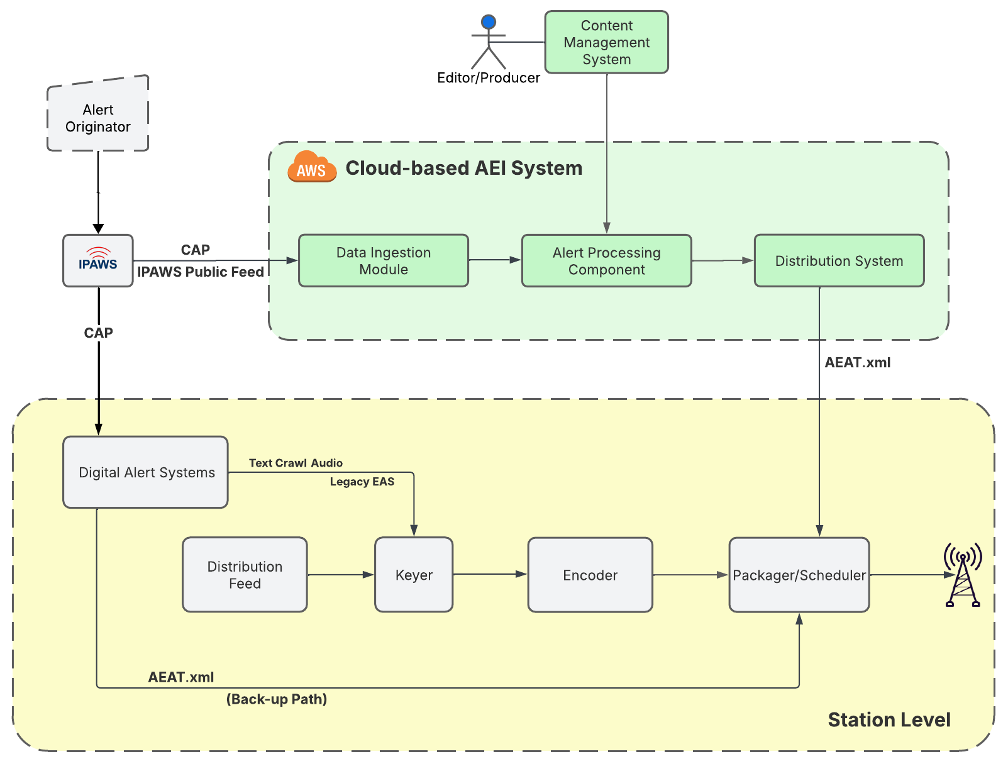
The proposed AEI System is designed to ensure scalability, redundancy, and real-time responsiveness. The System architecture can be divided into three key components: the Data Ingestion Module, the Alert Processing Component, and the Distribution System. Each component plays a crucial role in ensuring efficient and reliable alert management.
Data Ingestion Module
The Data Ingestion Module interfaces with the IPAWS CAP (Common Alerting Protocol) Public Feed. The IPAWS CAP receives real-time alerts from multiple emergency channels, including NOAA Weather Radio, EAS, and WEA [6]. Utilizing the IPAWS CAP Public Feed ensures a standardized and reliable method to aggregate alerts from multiple sources, and enables seamless integration, accurate data processing, and efficient transmission.
The Data Ingestion Module retrieves incoming alerts using Amazon EventBridge, a serverless event bus service that enables seamless event routing [7]. The Data Ingestion Module parses the alert types, identifies severity levels, and categorizes messages based on the type of emergency. Once the data is ingested and validated, it is passed to the Alert Processing Component.
Alert Processing Component
The Alert Processing Component transforms CAP messages to formats compatible with multiple delivery platforms. For IP-based systems, like news websites and mobile applications, the messages are converted to JSON or XML. For broadcast, the AEI System converts alerts to the Advanced Emergency Alert Table (AEAT) format used by ATSC 3.0 [8].
Both CAP and AEAT are formatted in XML, so the Alert Processing Component must map the essential CAP elements with the corresponding AEAT elements. This conversion ensures that emergency messages can be effectively transmitted over the air while maintaining all critical information.
The key conversion processes are listed below:
- Alert Identification: Each alert in the AEAT format requires a unique identifier, derived from the “identifier” field in the CAP message. This ensures traceability and prevents duplication in the alert Distribution System.
- Geographical Information: The AEI System extracts FIPS (Federal Information Processing System) codes from the CAP message and maps them to the corresponding broadcast Designated Market Areas (DMAs). This ensures that the Distribution System can target the impacted regions, allowing for precise and effective emergency alert distribution.
- Event and Priority Code Mapping: CAP messages contain event codes that specify the type of emergency. The Alert Processing Component extracts CAP event codes and maps them to the corresponding AEAT priority codes. The mapping allows the broadcaster to further customize alerts. For example, the Sinclair Broadcaster Application color codes the user facing alerts based on the severity of the emergency.
- Message Content Adaptation: The textual alert content from the CAP message is mapped to the AEAT message structure. This includes the alert description, instructions, and any available multimedia content.
Distribution System
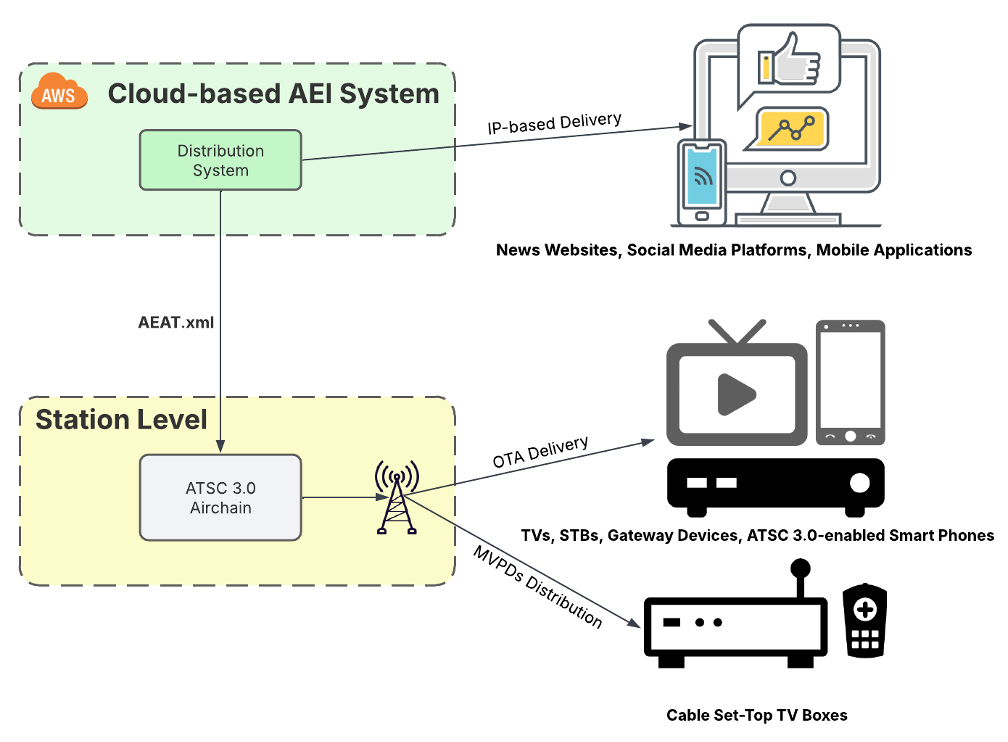
The Distribution System transmits the formatted alerts through multiple delivery channels to reach the widest possible user base. The alerts are sent out simultaneously via OTA transmission, IP-based platforms, multichannel video programming distributors (MVPDs), and other service providers.
- Over-the-air (OTA) Delivery: The AEI System interfaces with the ATSC 3.0 broadcast airchain through APIs. Nextgen TV-compatible devices, including televisions, set-top boxes, gateway devices, and mobile devices equipped with ATSC 3.0 receiver chips, can receive these emergency alerts. WEA messages can be delivered to both wireless devices and over-the-air television with the AEI System.
- IP-based Platforms: To reach audiences beyond traditional television, the AEI System delivers emergency alerts to IP-based platforms such as news websites, social media platforms, and mobile applications. This multi-platform strategy guarantees that users relying on mobile or internet-connected devices can receive real-time alerts, even if they are not viewing a broadcast service. Furthermore, the System provides geotargeting capabilities to allow alerts to be customized based on specific geographic regions using user location.
- MVPD Providers: The AEI System expands the distribution of emergency alerts to MVPDs. By integrating with the MVPD infrastructure, the System ensures the seamless delivery of emergency alerts to subscribers via set-top boxes, IPTV services, and other managed video platforms. Service providers can now incorporate alert metadata to improve the delivery of emergency messages, allowing for features such as forced tuning to emergency broadcasts, on-screen alert overlays, and the dynamic insertion of alert banners within video streams.
Newsroom Workflow
The AEI System is built as a plug-in to Sinclair’s Content Management System (CMS), Storyline [9]. Integrating the system into Sinclair’s CMS avoids increasing the workload of producers by creating a single platform to manage alerts, updates, and information efficiently within the existing infrastructure.
The System’s Broadcast Newsroom Flash (BNF) feature automatically sends high-severity alerts to the affected areas to avoid delay. Newsroom producers can then review the low-severity alerts and decide whether they need to be broadcast. This prevents alert jamming or unnecessary disruptions to the broadcast. Crucially, the BNF can also update distributed alerts with the latest information, and include images, maps, or video feeds.
In addition, the AEI System’s Broadcast News Advisory (BNA) feature allows newsrooms to distribute locally targeted information, such as road closures, school delays, or other community-focused updates.
With the AEI System, newsrooms can provide continuous updates and evolving emergency coverage, keeping communities informed as the situation unfolds.
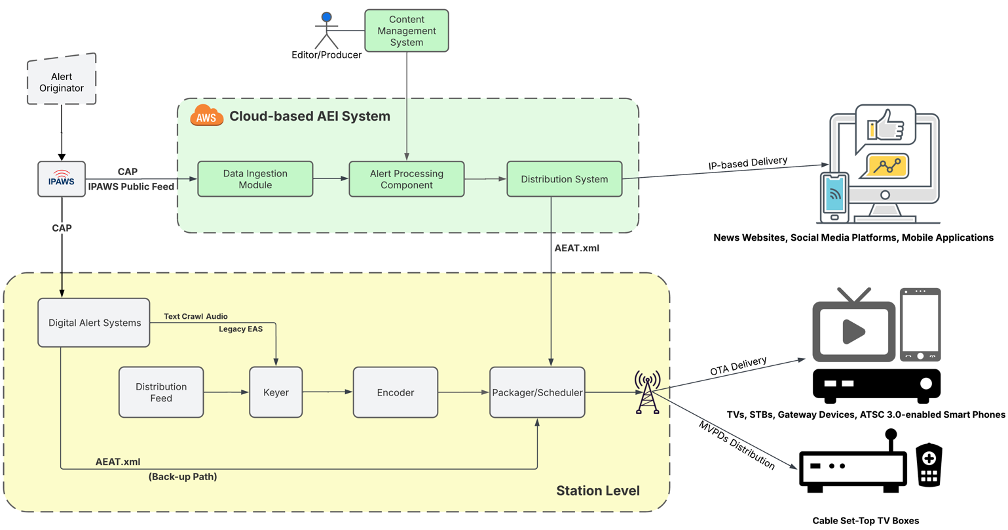
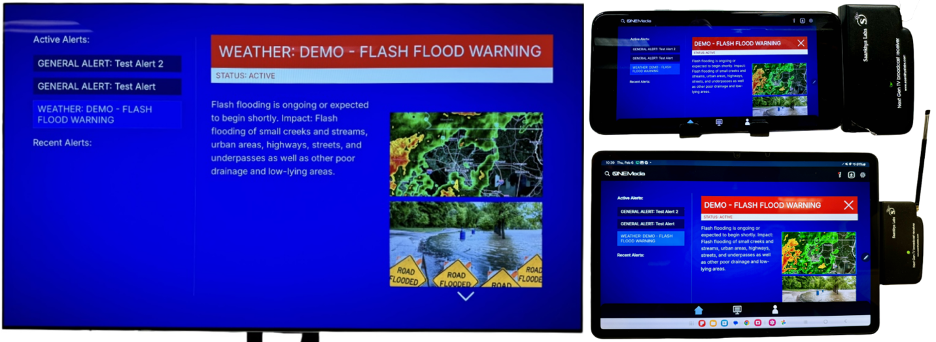
The AEI System has been tested and demonstrated to industry stakeholders at the ONE Media Technologies Lab in Hunt Valley, Maryland with support from the Federal Emergency Management Agency (FEMA).
Benefits of a Cloud-Based AEI System
A cloud-based system offers several benefits that enhance the efficiency, flexibility, and reach of emergency communications. These benefits are crucial for improving the distribution of emergency alerts across both traditional broadcast and IP-based platforms. The key benefits of the cloud-based AEI system are listed below:
- Scalability and Flexibility: Cloud infrastructure can dynamically allocate resources based on the volume of emergency alerts without being constrained by physical infrastructure. In addition, the flexibility of cloud infrastructure makes it easier for the system to integrate with new technologies as they emerge.
- Cost Efficiency: By utilizing cloud infrastructure, broadcasters can significantly reduce the expense of dedicated on-premises servers and hardware. Cloud service providers often offer pay-as-you-go pricing models to allow organizations to scale operations based on demand. This strategy guarantees that emergency alert systems stay cost-effective while maintaining high availability during emergencies.
- Reliability and Redundancy: Cloud service providers offer their services through an extensive network of redundant data centers. Key features such as automatic failover, traffic rerouting, and load balancing are designed to reduce service disruptions caused by technical failures or natural disasters.
- Analytics and Monitoring: Past alerts are stored in an internal database to track dissemination and engagement. Analytics and monitoring tools provide data-driven insights to help broadcasters refine emergency communication strategies and identify patterns in public responses.
Future Applications
The AEI System has the potential to evolve and expand beyond its current capabilities. Future advancements include:
- Multi-Language Support: AI-driven translation and text-to-speech capabilities could enable real-time translation of emergency alerts to ensure that critical information effectively reaches diverse audiences and individuals with accessibility needs.
- American Sign Language (ASL): The System could integrate with ASL solution providers to convert emergency messages into sign language to enhance the accessibility of emergency alerts for the deaf and hard-of-hearing community.
- Internet of Things (IoT) Devices: Emergency alerts can also be delivered to IoT devices. Public displays such as digital signage and public transportation information systems can provide real-time emergency alerts for widespread communication.
Conclusion
The cloud-based Advanced Emergency Information (AEI) System proposed in this paper offers a scalable, flexible, and reliable solution for modern emergency communication. The paper addresses key challenges across diverse broadcast and IP-based service platforms and provides ONE Media’s implementation for enhancing public safety in the digital age. By integrating with the IPAWS CAP public feed and leveraging the capabilities of both ATSC 3.0 and cloud infrastructure, the AEI System ensures a standardized and reliable method for aggregating alerts from multiple sources and reaching a broad and diverse audience.
Ongoing and future work is focused on testing the System in real-world scenarios, refining its scalability, and exploring additional features to address accessibility needs.
References
- ATSC 3.0 Advanced Emergency Information System Implementation Guide
- https://www.fcc.gov/emergency-alert-system
- https://www.atsc3advocate.com/_files/ugd/713d71_383b0e6b00ae4e369e4bf75f914694ea.pdf
- https://www.fcc.gov/consumers/guides/wireless-emergency-alerts-wea
- https://www.nytimes.com/2025/01/10/us/los-angeles-false-evacuation-alert.html
- https://www.fema.gov/emergency-managers/practitioners/integrated-public-alert-warning-system
- https://aws.amazon.com/eventbridge
- ATSC 3.0 Standard. A/331:2024-04, “Signaling, Delivery, Synchronization, and Error Protection”
- https://sinclairdigital.com/storyline-product-pg