
Reinventing Emergency Alerts for the Connected Age
How ONE Media’s Cloud-Based AEI System Is Helping Keep Communities Safer
Broadcasters have long been on the forefront of emergency alerting. The robustness of the broadcast signal combined with its wide reaching one to many architecture, mean it is uniquely placed to inform communities when disaster strikes. But as the world has switched to internet-based communications, many internet first and mobile first users miss out on the lifesaving benefits of broadcasting. Messages arrive too late, go to the wrong people, or never show up at all.
To combat this, ONE Media has developed a cloud-based Advanced Emergency Information (AEI) System that modernizes public safety alerts for the 21st century. Built on the backbone of ATSC 3.0, the next-generation broadcast standard, this system brings the robustness and reach of traditional broadcasting to IP services, reaching people where they are, with the reliability so crucial in an emergency.
Today’s Alert Systems Are Outdated
Today’s emergency alerts fall into two main categories. The Emergency Alert System (EAS), which is broadcast over TV and radio, and Wireless Emergency Alerts (WEA), which are sent directly to mobile phones. EAS is reliable and robust but only reaches those who are actively watching or listening to traditional broadcast media. WEA, on the other hand, can reach people on the go, but it is more prone to failure, hampered by character limits, poorly targeted, and easily ignored.
Both systems have limitations. As audiences move away from traditional TV, EAS becomes less effective. Meanwhile, WEA messages can be delayed or lost during times of network congestion, and their geographic targeting is often imprecise. Accessibility remains a challenge, particularly for the deaf and hard-of-hearing, and there is little coordination across platforms as TV, mobile apps, websites, and social media typically operate in silos rather than as a unified alerting system.
A Smarter, Cloud-Based Emergency Alert System
ONE Media’s AEI System solves these problems by combining the reach and robustness of broadcast TV, with the agility of cloud computing, and the ubiquity of IP-based delivery.
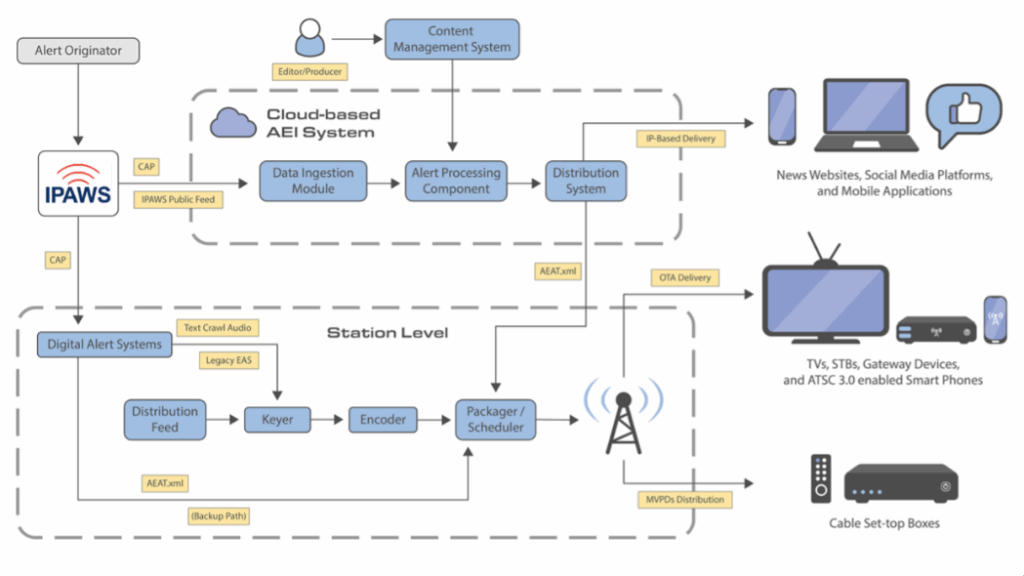
The system connects to the FEMA IPAWS alert feed, which amalgamates emergency messages from sources such as NOAA Weather Radio, fire departments, and public safety agencies. This ensures that users receive the most up to date information from the authorities on the ground.
The system retrieves incoming alerts using Amazon EventBridge and processes them. The alerts are validated, categorized by severity and type of emergency, then passed on to the Alert Processing Component. Here they are translated into multiple formats and prepared for delivery.
Finally, the alerts are simultaneously broadcast to multiple platforms. Broadcasters deliver the alerts to Next-Gen TV compatible devices such as TVs, set-top boxes, and mobile devices with ATSC 3.0 receiver chips. WEA messages can be delivered to both OTA and wireless systems.
The AEI system also delivers alerts to IP-based platforms like news websites, social media platforms and mobile apps. The system also expands its reach to MVPD providers by integrating with the MVPD infrastructure. This methodology ensures the widest reach across platforms, ensuring the largest number of people get the information they need when it matters most.
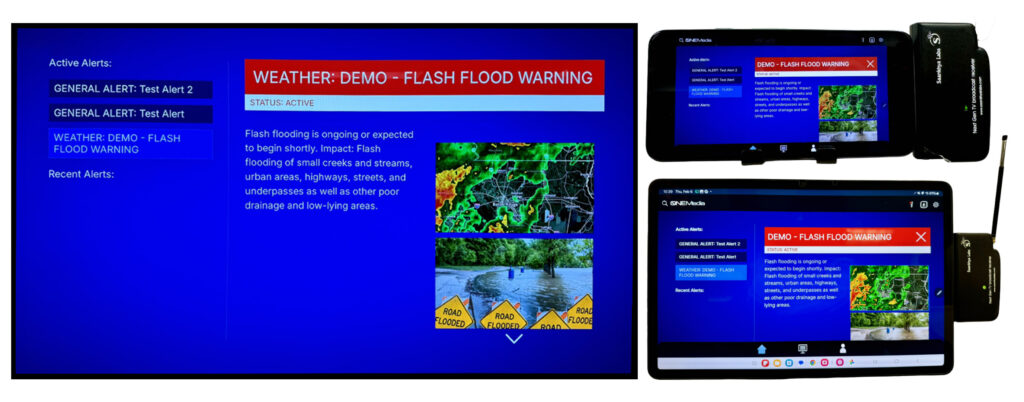
The benefits of the system don’t stop at reach and robustness. ATSC 3.0 is built on an IP backbone, designed specifically to integrate with the systems of our modern communications network. This means that emergency alerts can be enhanced with images, videos, and graphics to further inform affected viewers.
By using cloud delivery, the system ensures that alerts reach the public with minimal delay, even during periods of network congestion. Smarter targeting capabilities use location data to minimize over-alerting, helping to reduce alert fatigue and improve public trust.
This system is designed with accessibility in mind, with future enhancements including multilingual support, American Sign Language integration, and delivery to public displays and smart devices. Additionally, built-in cloud redundancy ensures that alerts continue to be delivered even if local infrastructure is damaged, enhancing overall reliability.
The Future of Emergency Communication
Emergencies don’t wait, and they don’t care what screen you’re looking at. We’re building the next generation of cloud-based, multi-platform public safety infrastructures, that’s deeply integrated with both broadcasters and digital networks.
Broadcasting remains a vital, resilient link in our public safety chain, that only stands to gain as the we transition fully to the NextGen TV standard.