
ATSC 3.0 B2X: A Way Towards O-RAN Compliance for Broadcasting
Rashmi Kamran, Mohamed Niaz Mohamed, David Starks, Michael Simon, Sangsu Kim, Joe Fabiano
Abstract – Open Radio Access Network (O-RAN) disaggregation brings a set of transformative advantages to any access technology in terms of scalability, flexibility, and vendor interoperability. The disaggregated architecture enables independent nodes to align with the nature of deployment resulting in a cost-effective high-performance network. The well-defined interfaces between the nodes, with structured information elements, facilitate seamless Artificial Intelligence (AI) integration for intelligent performance optimization, live diagnostics, energy efficiency and network resilience.
ATSC 3.0 and ATSC Broadcast-to-Everything (B2X) access technologies are Internet Protocol (IP)-native, and B2X aligns well with O-RAN principles. This B2X solution would leverage the O-RAN ecosystem for optimized hardware with B2X software to customize the broadcast functionality. This paper highlights the benefits of disaggregating B2X infrastructure for broadcasting technologies in alignment with O-RAN principles. The paper covers B2X description, Radio Access Network (RAN) architecture, RAN functional blocks, B2X Enhanced Common Public Radio Interface (eCPRI) functional split, and broadcast-specific network functionalities.
This paper proposes a flexible software-defined broadcast network (ATSC B2X network) that is future-proof and scalable, with underlying hardware to support vendor-independent compatibility and maximize availability. This architecture promotes experimentation within limited geographic areas by modifying a few nodes without affecting the overall network performance.
B2X disaggregation aims to blend the technological advancement of the wireless infrastructure, with the simplicity and cost-effective nature of a broadcast network. Further details are presented to showcase the working principles and advantages of O-RAN-aligned B2X technology.
Introduction
Traditional broadcast systems are monolithic in nature and optimized for a single use case such as television. The traditional Third Generation Partnership Project (3GPP) mobile systems are also monolithic in nature, with the RAN system components usually being provided by a single vendor and treated as a black box by the mobile operator. This limits service flexibility and innovation while keeping the RAN cost high, and has been termed “vendor lock-in.” Maintaining such systems and handling obsolescence increases the operational expenditure. Additionally, upgrading such systems to support innovations, enhancements and expansions were prohibitively expensive as it required the entire monolithic hardware equipment set to be replaced.
Mobile communication infrastructure experienced similar vendor-lock challenges prior to the emergence of O-RAN and Fifth Generation New Radio (5G NR) technologies. Moreover, 3rd generation mobile communication standards (Universal Mobile Telecommunications System (UMTS)) introduced modularized entities with specific functionalities, and standard interfaces between the nodes allowing a level of multi-vendor participation. Common Public Radio Interface (CPRI) standards have further enabled radios to be separated from the base stations, though vendor interoperability was still a challenge. Prior to the CPRI interface, the baseband processing unit was co-located with the Radio Frequency (RF) unit as shown in [1], requiring use of high-power RF cables from the baseband unit to the tower-top antennas. Then, enhanced CPRI [1] termed eCPRI emerged and allowed a packet-based ethernet interface for separating RF processing from baseband which need not be co-located with the radio unit at cell site. O-RAN built an Open Front-haul interface based on eCPRI using packet-based Ethernet.
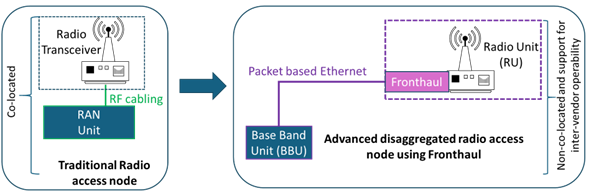
O-RAN standards have further advanced disaggregation to make vendor interoperability a feasible reality with rigorously defined interoperability specifications. The RAN nodes were grouped based on the core processing nature and latency tolerance. The Centralized Unit (CU) handles network centric functions with non-real-time requirements, while low-latency processing with near-real time requirements are handled by the Distributed Unit (DU). The real-time processing and radio waveform generation is handled by Radio Units (RUs) at cell sites. This O-RAN modular split enabled vendors to have specialized products for just one of these units by using well defined interfaces. The innovation sparked by having multiple vendors with open interfaces is limitless over a monolithic black-box single vendor approach and have been adopted by the wireless industry and is central to O-RAN.
In modern mobile networks the 5GNR RAN is disaggregated and interfaces defined aligned with cloud-based RAN processing. O-RAN Alliance [2] using the 5GNR standard provides disaggregation, virtualization, intelligent RAN controllers and open interfaces that also use a cloud-native service-based architecture for the RAN. O-RAN has also defined an Open Front-haul [3] between 3GPP disaggregated functions O-DU cloud and the O-RU at cell sites. Moreover, this cloud-native service-based RAN architecture’s flexibility brought the potential to realize the 5GNR use cases envisioned which require Network Slicing [4].
Additionally, the disaggregation, virtualization, intelligent RAN controllers and open interfaces (offered by O-RAN) enable artificial intelligence using RAN Intelligent controllers and Service Management and Orchestration (SMO) to monitor and manage resources. Intelligent monitoring reduces manual overhead and increases the robustness of the network infrastructure through remote diagnostics, predictive maintenance and automated contingency measures
Bringing O-RAN AI automation to broadcast infrastructure can boost innovation and flexibility at competitive pricing while promoting vendor interoperability. O-RAN architecture can enable centralized content generation and staging at edge while regional content mix and resource allocation is maintained at regional level. Such a resilient network can act as a secondary backbone for the emergency alerts and can be restored quickly after natural disasters. A broadcasting RAN is being designed in ATSC for the B2X system which is a step towards bringing the advantages of O-RAN into broadcasting. This paper highlights the benefits of applying O-RAN in broadcasting and proposes a new RAN design named as B2X RAN (BRAN) that is based on O-RAN principles. It also defines a new eCPRI based Front-haul for BRAN with some working principles discussed.
O-RAN based architecture
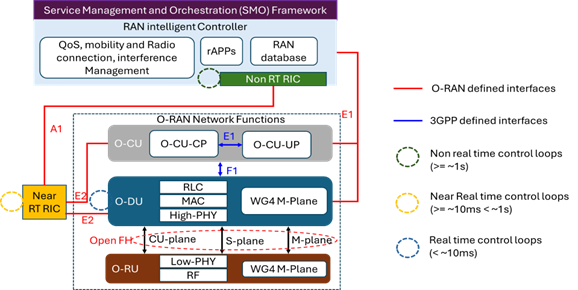
O-RAN architecture follows disaggregation, with complex baseband processing centralized at the DU, and real-time-specific Digital Signal Processing (DSP) performed at the RU. In this concept, DU acts as a synchronization source. As a result, O-RAN zero-touch provisioning can be achieved, enabling upgrades to specific nodes rather than the entire system. A high-level O-RAN architecture is shown in Fig. 2, which mainly consists of two subsystems: the service management and orchestration framework.
Service management and orchestration (SMO) Framework:
In O-RAN architecture, the SMO framework is a cloud-native service-based architecture responsible for service management at the RAN level. O-RAN specifications do not provide implementation guidelines, but the logical functions for SMO are defined. Key functionalities defined for SMO are as follows: RAN analytics, RAN network functions performance assurance, fault supervision, provisioning management, service and slice subnet orchestration, AI-related management, etc. (referred from Clause 5.3.1.2 of O-RAN.WG1.TS.OAD-R004-v15.0.0) [7]. SMO capabilities extensions include interaction with external systems which is not shown in Fig. 2.
RAN Intelligent Controller
The Non-Real-Time RAN Intelligent Controller (Non-RT-RIC) is an integrated part of SMO. It is responsible for RAN-associated management, particularly Quality of Service (QoS), mobility, radio connection provisioning, and interference management. In this subsystem, Non-RT RIC Applications (rAPPs) are plug-and-play components/applications that implement custom logic to collect information from RAN components and connect it to a non-real-time RAN intelligent controller. Based on the use case, control loops can exist at the Non-RT RIC, Near-RT RIC, or O-DU. However, the timing of these control loops depends on the use case. Fig. 2 shows typical execution timing for these control loops. RAN database is a collection of RAN-related analytics that can also be helpful for AI integration, which needs learning data. Further AI modules can also be integrated into this subsystem. Overall, this subsystem has complete knowledge of the underlying RAN functions and orchestrates and manages them in coordination with the core network.
Near-Real-Time RAN Intelligent Controller (Near-RT RIC)
This module in the O-RAN architecture handles near-real-time (Near RT) control and optimization of RAN functions and hosts Near-RT RIC Applications (xAPPs) to provide this functionality. It collects policies and control inputs from SMO via the A1 interface. It interacts with RAN nodes via the E2 interface to collect information. A1 and E2 are O-RAN-defined interfaces that any type of O-RAN-compliant RAN can use.
O-RAN Network Functions and Associated Interfaces
O-RAN network functions are based on further disaggregating the existing RAN disaggregation for 3GPP 5G RAN. 3GPP 5G RAN disaggregates the RAN node into Centralized Unit (CU) and Distributed Unit (DU). Under the O-RAN principle, the RAN comprises three components: O-CU, O-DU, and O-Radio Unit (RU). O-RAN provides options for dividing functionality among these functions, which adds flexibility. In [2] one option is shown for explanation. O-CU is based on the same functionalities as 3GPP CU, with O-DU including physical layer, Medium Access Control (MAC), and Radio Link Control (RLC) Layer, along with the O-RAN M-Plane component for managing O-RUs. O-RU functionalities include physical layer and radio-frequency components, as well as M-plane components, for interaction with O-DU M-plane components. There is an O-RAN-specified Front-haul between O-DU and O-RU, which is logically divided into the Control and User Plane (CU-plane), the synchronization plane (S-plane), and the Management plane (M-plane). O-Front-haul is specified as an eCPRI interface, which is detailed in [2]. E1 and F1 are 3GPP-defined interfaces within O-RAN, where E2 is the O-RAN-defined interface for exchanging management-related communication between O-CU, O-DU and Near RT-RIC under SMO.
O-RAN Key Features
Following are key features of the O‑RAN–based architecture that provide unique advantages across multiple aspects of the system.
- Latency-critical and time sensitive support: The O-RAN disaggregation permits separation of the O-DU and O-RU RAN functions, while ensuring tight synchronization among functions tracing to a common primary reference clock. This enables the O-DU functions to be located in an edge data center or cloud, far away from the Cell site while fulfilling 5GNR latency requirements.
- Flexible split options: In O-RAN, the options are Front-haul interface in O-RAN termed 7.2X between O-DU and O-RU, there can be a Midhaul interface between O-CU and O-DU and finally a Backhaul interface between O-CU and 5G Core network.
- Open, Disaggregated Architecture: The well-defined open interfaces such as Open Front-haul between Distributed and Radio Units, E2 interface between RIC and RAN nodes, AI interface between Non-RT and Near RT RICs, and O1 for management enable multi-vendor interoperability resulting in reduced vendor lock-in.
- Native AI/ML Integration via RIC: The Near-RT Radio Intelligence Controller (RIC) that optimizes radio functionalities in real-time and the non-RT RIC that optimizes overall system functionality based on a policy, enable network optimization from traffic, energy and self-organization perspectives, making the system AI-Native.
- Cloud-native service-based architecture (SBA) for the RAN: The result of O-RAN disaggregation, virtualization, RAN Intelligent Controllers and open interfaces makes the RAN flexibly programmable, which is required for network slicing use cases and is synergistic with AI principles for RAN. [10]
- Better observability & Analytics: The standardized telemetry and the real-time Key Performance Indicators (KPIs) exposed through open interfaces enable predictive maintenance and improved fault isolation, leading to a highly reliable network with near-zero downtime.
- Faster Innovation Cycle: The software defined upgrades and Continuous Integration/Continuous Delivery (CI/CD) pipelines empowers the developers to rapidly introduce new innovations through canary rollouts, enabling controlled experimentation with minimal network impact, and seamless large-scale deployment, that reduces innovation cycle exponentially.
- Network Energy Efficiency: The traffic aware cell activation, AI-enabled sleep modes and dynamic spectrum allocation promotes network energy efficiency optimization leading to reduced carbon footprint aligned to the sustainability goals.
Potential Benefits of O-RAN Disaggregation from a Broadcasting Perspective
O-RAN disaggregation, virtualization, intelligent RAN control with open interfaces brings a cloud-native service-based architecture structure for Multicast Broadcast RAN that enables artificial intelligence to monitor, optimize and reallocate resources when needed. This includes use of intelligent scheduling through the distributed Application (dAPP) [11] with real-time closed loops in DU. The intelligence can also perform predictive maintenance and automated contingency measures enabled through intelligent monitoring that increases robustness and resiliency and efficiency of the virtualized shared network infrastructure. Adoption of O-RAN principles to broadcast/multicast standard can bring following key benefits:
- Support for Single Frequency Network (SFN) deployment with multiple RU topology options
- Cloud friendly service-base RAN architecture
- Easier interworking with other networks adopting O-RAN principles and Interfaces
- Readiness for AI integration
- Enhanced RAN resource optimization support
- Intelligent Orthogonal Frequency Division Multiple Access (OFDMA) spectrum sharing
- Provisioning of non-real time and near real time RAN intelligent control
- Support for slicing in broadcasting
However, the application of O‑RAN principles within the broadcasting domain remains unexplored. This paper aims to fill this gap and focuses on applying O-RAN principles in broadcast network design.
The O-RAN system architecture described in above section is optimized and used for the first time for ATSC B2X release design and physics of Multicast Broadcast RAN infrastructure to enable network slicing under a shared neutral host architecture [9] aligned with 5GNR principles. B2X enables interworking and convergence that is mutually beneficial to all network operators, while using a shared scarce resource spectrum efficiently and cost effectively in the future.
B2X System Introduction and Design Guidelines
B2X is a multicast/broadcast system that delivers IP services over-the-air. B2X RAN is designed based on virtualization, intelligent RAN control with open interface RAN, similar in structure to modern telecom RANs [2]. It separates the multicast broadcast functions in BRAN into BCU, BDU, and BRU blocks so the system can be deployed in software, scaled across many sites, and upgraded without replacing the whole chain. In addition, B2X system includes a Broadcast Core Network (BCN) (as shown in Fig.3) which is responsible for network access provider functionalities and forwarding the traffic of advanced services from Advanced Service Operator Systems (ASOS) to the BRAN and then delivered to B2X Broadcast End point (BXE) via BRAN. The design of the B2X system is such that it can also manage the offloading of traffic from a 3GPP system. Application-level two-way communication with BXEs is possible via any generic IP networks.
The B2X system is aligned with 5GNR and O-RAN principles to enable an optimized B2X multicast broadcast RAN. The B2X system under O-RAN orchestration can provision OFDMA resources for B2X slicing with slice categories offering different BXE use cases. The categories of slice types are: BXE wide adaptive bandwidth (BW) slices, BXE fixed narrow BW slices, BXE converged 5G/6G User Equipment (UE) slices.
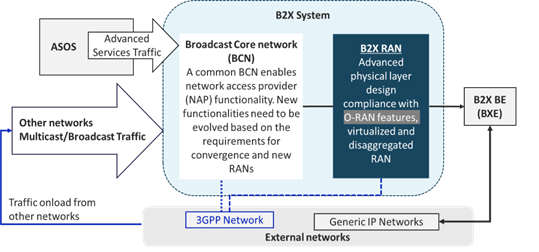
The B2X standard describes a flexible framework supporting B2X slicing using OFDMA. This permits BXE category slices which are totally isolated to use the pooled spectrum of multiple RF carriers. Enabling a shared B2X network topology with multiple operators, tenants, all benefiting from the economics of a virtualized neutral host network for the broadcast, International Mobile Telecommunications (IMT) bands [8].
To support the above features, design guidelines for BRAN focuses on applying selected O-RAN features so the BRAN is modular and scalable:
- Disaggregate into BCU/BDU/BRU with clear interfaces, keeping time-critical baseband and scheduling near the BDU/BRU while placing longer timescale coordination in the BCU
- Use open, well-defined interfaces to support multi-vendor deployment and independent upgrades
- Enable automation and lifecycle management (configuration, monitoring, fault handling) using an O-RAN style management approach as the network scales.
A focus of this paper is to highlight BRAN compliance with O-RAN principles. The following section describes the BRAN architecture in greater detail.
B2X RAN Disaggregated Architecture
The B2X Radio Access Network (BRAN) adopts a disaggregated architectural model aligned with O-RAN principles, while being optimized for the unique characteristics of multicast and broadcast transmission. Unlike unicast-centric mobile systems, B2X is designed for deterministic, large-area service delivery and efficient spectrum utilization across shared broadcast resources. This architectural approach reflects a shift from traditional monolithic broadcast systems towards a programmable multi-service “broadcast-to-everything” platform capable of supporting diverse data, media, and signaling applications with quality-of-service differentiation.
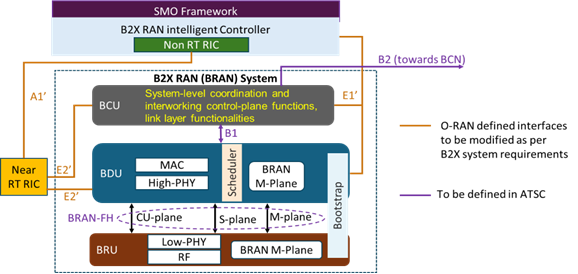
In this paper, the BRAN is scoped specifically to the link layer, MAC layer, and physical layer functions required for broadcast waveform generation, system discovery, synchronization, and user-plane delivery. At a high level, the BRAN is structured around three functional entities: the B2X Centralized Unit (BCU) at the link layer, the B2X Distributed Unit (BDU) at the MAC and High-PHY layers, and the B2X Radio Unit (BRU) at the Low-PHY layer, as illustrated in [4]. These entities are defined by a functional role rather than a physical realization, allowing implementations to range from fully centralized cloud deployments to edge-distributed realizations depending on network topology, geography, and operational objectives. This partitioning harmonizes with O-RAN disaggregation principles while remaining independent of specific hardware or virtualization models.
BCU System Coordination Layer
The BCU provides system-level coordination and interworking control-plane functions that interface the BRAN with external network domains. It operates outside the real-time waveform generation and RF transmission domains. By separating longer-timescale policy, service coordination, and interworking logic from time-critical processing, the BCU enables independent evolution of higher-layer control mechanisms without impacting air-interface determinism. This separation supports scalable orchestration, multi-tenant operation, and alignment with O-RAN management concepts.
BDU Baseband and Scheduling Layer
Time-critical digital baseband processing is performed within the BDU. The BDU assembles the B2X broadcast waveform using OFDMA-based time–frequency resource structures and scalable system discovery signaling mechanisms, including Slice Start (SS) bootstraps and associated Layer-1 signaling. These mechanisms extend ATSC 3.0 foundations while introducing transformative physical-layer enhancements to support diverse multicast and broadcast services beyond traditional linear television.
The BDU hosts DSP-intensive baseband processing that is time-critical but not RF-realized, allowing these functions to be centralized or used at the network edge depending on deployment requirements.
The B2X scheduler is treated as a logical function closely associated with the BDU, reflecting its tight coupling to waveform assembly and timing constraints. Unlike legacy broadcast systems with largely static allocation, the B2X scheduler dynamically organizes OFDMA-based time–frequency resources across Virtual Bandwidth Parts (VBPs) to efficiently support multiple slice categories and service types. Scheduler decisions may be assisted by O-RAN-aligned dAPP frameworks [11] operating within the BDU, enabling real-time resource optimization while preserving deterministic broadcast behavior.
BRU RF Realization Layer
The BRU performs the final stage of Low-PHY processing and RF waveform realization for transmission at the antenna air interface. It supports both omnidirectional SFN deployments (BRU Category B) and sectorized SFN deployments (BRU Category A) enabling geographic targeting while preserving coherent SFN operation. The BRU operates strictly under timing and control context provided by the BDU and does not perform scheduling or higher-layer control functions. This separation ensures that RF implementation and site topology can evolve independently of waveform definition and resource scheduling logic. The ability to maintain coherent SFN operation while enabling sectorized geographic targeting provides a practical foundation for interworking and spectrum coexistence with 3GPP systems.
Waveform Separation and Front-haul Interface
A key architectural principle of the BRAN is the separation of waveform definition, waveform assembly, and waveform realization across functional entities. The structure and semantics of the transmitted waveform remain independent of functional placement, enabling flexibility in deployment while maintaining a consistent air interface. The BRU is connected to the BDU via the B2X eCPRI Front-haul interface, which transports frequency-domain and time-domain baseband components together with timing and control context required for precise waveform realization. This intra-PHY split enables deterministic broadcast transmission while leveraging packet-based transport consistent with O-RAN principles.
Working principle
The operation of the BRAN is inherently unidirectional, reflecting its broadcast and multicast nature. The B2X digital baseband signals are generated in the BDU and sent via the B2X eCPRI protocol to the BRU, where they are assembled into an RF waveform and emitted at the antenna air interface at the precise transmission time signaled by the BDU. The B2X Front-haul architecture is realized respecting the physics of multicast broadcast by using an adaptation of the eCPRI protocol [1, 17], originally intended for unicast transmission in LTE and 5G NR transport.
B2X eCPRI design and procedures
The proposed B2X eCPRI acts as an application specific Front-haul interface that carries the baseband components of the B2X waveform from the BDU to the BRU (as shown in Fig. 5). The B2X digital baseband signal is transferred over the Front-haul interface using time-domain In‑Phase and Quadrature (I/Q) symbols and frequency-domain I/Q symbols for the final leg of Low-PHY real-time processing at the BRU along with the timing and signaling required to assemble these components into RF waveforms for real-time transmission.
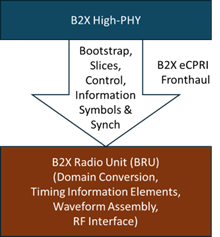
Given the intra-PHY nature of the split, the B2X eCPRI interface is time sensitive. However, the Front-haul link uses eCPRI as the transport layer which uses packet-based transport and is vulnerable to packet delay variation. B2X eCPRI protocol mitigates this challenge by transferring the information at its base components prior to building it into a time critical sample stream. The information is represented in base modular components and encoded in a compressed form, with a label to identify the component, coded with adequate timing and sequence information enabling the B2X RU to reproduce the waveform in the intended form.
Being a broadcast Front-haul, it carries unidirectional traffic from BDU to the BRU. However, the various types of devices and services supported by B2X require unique signaling, framing and synchronization which is designed by B2X eCPRI layer, while adhering to the eCPRI protocol as the underlying transport protocol. The Interface is logically split into four planes that includes Control, User, Synchronization, and Management planes. Other than Management plane, other planes are described in following sections.
Control plane
B2X eCPRI control plane is designed to function as a transmission scheduler that modularizes B2X transmission waveforms into categorized components and schedules B2X waveform information blocks over airtime unambiguously. Each of the B2X waveform components is encoded with a unique optimal structure that aligns to its physical and logical characteristics, while unambiguously marking its transmission time. The control plane develops a systematic schedule, creates a logical timeline place holder that prepares the radio unit with the context of information arrival. B2X control plane messages inform the RUs about the key characteristics of the upcoming user plane information that includes component type, sequence order, transmission time and length of the information.
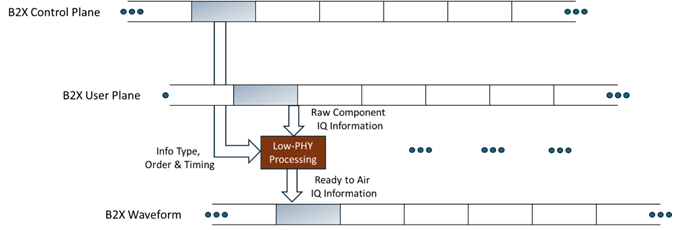
Each of the user plane information blocks is referred to by the control plane using a unique information block identifier specific to the component type that ensures user plane contents fill the right timeline place holder, while allowing the receiving entity to flag on missing information, untimed arrival (delayed or early) and deeper interface health statistics that can be used for system level diagnostics and predictive maintenance. The control plane structures are designed to support future standard enhancements while being lean in overhead.
User plane
B2X eCPRI User plane carries the raw component I/Q information content from the BRAN High-PHY towards transformation into B2X transmission waveform at the radio unit as shown in Fig. 6. The user plane messages are the largest message blocks and hence are optimized for minimal overhead. Each of the user plane messages is attached to its control plane descriptor via component type, component transmission time and the unique identifier. This enables faster protocol processing and a thin layer of overhead which is essential to minimize the capital and operational expenditure.
Each of the information blocks is uniquely associated with a control plane descriptor that informs the radio unit on the type of transformation to be used, order in which the transformed block to be transmitted and cross referential alignment to other B2X waveform components for generating the intended target composite B2X waveform. It supports minimal overhead formats to carry time and frequency-domain I/Q traffic which is coupled to C-Plane with section type, section identifier and transmission time of the B2X component. This future-proof design supports a range of sample rates, bandwidths and numerologies for quad-aligned I/Q sample blocks for fast processing.
Synchronization
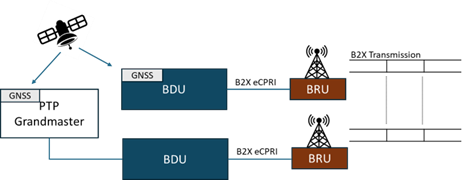
B2X eCPRI synchronization provides the radio unit with the time and frequency synchronization that is essential for timed assembly of processed waveform information into a transmit ready time-domain sample stream [5]. The radio unit is synchronized via B2X eCPRI network synchronization from the BDU using Precision Time Protocol (PTP) and optional robustness with Physical Layer Frequency Signals (PLFS).
All the synchronization procedures are aligned to ITU-T G.8275.1 telecom profile for telecom applications based on the IEEE 1588 precision timing protocol. BDU can either act as a Primary Reference Time Clock (PRTC) with an onboard Global Navigation Satellite System (GNSS) receiver or can attain its synchronization from a remote PRTC with G.8275.1 compliant upstream to act as a T-TSC compliant to G.8273.2 with additional necessary filtering as required to support B2X air interface timing requirements. It is essential for both the BDU and BRU to be either at a locked or holdover state for the BRU to transmit B2X synchronously to other transmission stations. The synchronization state of BDU and BRU is monitored by the BDU to ensure that transmission is permitted only with adequate synchronization state.
Open directions
O-RAN in broadcasting is an evolution for broadcasting networks, opening the way for multiple directions, such as investigating a standard broadcast Front-haul that any broadcast technology can use. The AI integration framework needs to be worked on in detail to leverage the advantages of AI in broadcasting at the network and service levels. Similar to BRAN, BCN functions can also be studied for further virtualization and cloud processing, applying O-RAN principles. Open Application Programming Interface (APIs) can be developed to support policy‑based offloading of multicast/unicast traffic, shared spectrum coordination, unified service-layer signaling, and cross‑network QoS management, which can be very useful for making interworking easier. A security framework for O-RAN based broadcasting is also a critical dimension for adopting zero-trust-like trends in broadcasting. Lastly, an open test and integration framework for O-RAN-based broadcasting networks can accelerate innovation to help reduce vendor lock‑in.
Conclusion
Broadcast systems require a fundamental shift in architectural approach, including generalized content generation, regionalized tactical scheduling to optimize interference and resource utilization, and neutral-host models that decouple tower infrastructure from service providers, including traditional broadcasters and future multicast service operators. By applying O-RAN disaggregation principles to a broadcast-centric, OFDMA-based physical layer, the BRAN architecture enables a flexible and scalable broadcast-
to-everything platform that extends well beyond traditional linear television services. This new design of
BRAN opens new opportunities for extended services in broadcasting and provides enhanced readiness for AI integration. In addition, interworking with other networks can be made easy with this design approach.
References
- eCPRI version 1.2 eCPRI_v_1_2_2018_06_25.pdf
- O-RAN Alliance O-RAN ALLIANCE E.V
- Control, User and Synchronization protocols O-RAN Open Fronthaul: https://specifications.o-ran.org/download?id=952
- O-RAN slicing related use cases, requirements and architecture https://specifications.o-ran.org/download?id=863
- K. Alam et al., “A Comprehensive Tutorial and Survey of O-RAN: Exploring Slicing-Aware Architecture, Deployment Options, Use Cases, and Challenges,” in IEEE Communications Surveys & Tutorials, vol. 28, pp. 1637-1678, 2026, doi: 10.1109/COMST.2025.3598406.
- D. Kefalas, N. Makris, T. Korakis and S. Fdida, “Traffic Steering for O-RAN Multi-RAT 5G Networks Using ML-Based Demand Forecasting,” 2025 IEEE Conference on Network Function Virtualization and Software-Defined Networking (NFV-SDN), Athens, Greece, 2025, pp. 1-6, doi: 10.1109/NFV-SDN66355.2025.11349598.
- O-RAN.WG1.TS.OAD-R004-v15.0.0) https://specifications.o-ran.org/download?id=932
- M. Polese, L. Bonati, S. D’Oro, S. Basagni, and T. Melodia, “Understanding O-RAN: Architecture, Interfaces, Algorithms, Security, and Research Challenges,” IEEE Communications Surveys & Tutorials., vol. 25, no. 2, pp. 1376–1411, Jan. 2023.
- L. Bonati, M. Polese, S. D’Oro, S. Basagni, T. Melodia, “NeutRAN: An Open RAN Neutral Host Architecture for Zero-Touch RAN and Spectrum Sharing,” IEEE Transactions on Mobile Computing, August 2023
- AI-RAN Alliance Home – AI-RAN Alliance
- dApps for Real-Time RAN Control: Use Cases and Requirements nGRG-RR-2024-10-dApp use cases and requirements_v2.21