
Standardized but Sleeping: Awakening a Forgotten Feature Wake Up Bits
Jason Kim, ONE Media
Abstract – The ATSC 3.0 Wake-up feature enables emergency alerts to activate compatible receivers to ensure critical information reaches audiences at risk. Building on next-generation capabilities such as enhanced video, immersive audio, and interactive services, ATSC 3.0 integrates Wake-up signaling through both the Bootstrap signal and the Advanced Emergency Alert Table (AEAT). This paper provides an in-depth examination of the Wake-up mechanism, its technical implementation across the physical and service layers, and its practical implications for broadcasters, device manufacturers, and public safety organizations.
Introduction
The recent Verizon outage in January 2026 was a timely reminder that true resilience depends on diverse, independent alerting paths. Mobile networks are important but not sufficient on their own. Broadcasters operate a uniquely resilient, one-to-many infrastructure designed to remain on the air during disasters. Emergency Alert System messages delivered over broadcast radio, television, and cable do not rely on cellular networks that become congested and often fail during emergencies. As a result, broadcast alerts often remain operational when mobile service is unavailable and may become the critical last-mile notification path during large-scale outages, reaching entire communities simultaneously without congestion or per-user network load. Redundancy across multiple public alert and warning channels is not optional, it is essential, and broadcast’s independent infrastructure is a foundational pillar of that resilience.
With the next-generation broadcast standard, ATSC 3.0, broadcasters gain improved video quality, immersive audio, interactive services, and enhanced emergency alerting and informing capabilities. One key advancement is the ability to wake up receivers from standby mode during emergencies, helping ensure timely and effective public communication. This function is enabled by wake-up bits carried in the Bootstrap signal and the Advanced Emergency Alert Table (AEAT).
System Overview
The ATSC 3.0 Wake-up feature supports enhanced emergency alerting through coordinated signaling and data delivery that enables receiver activation and rich alert presentation. The Bootstrap signal of the ATSC 3.0 transmission, often called the “universal entry point” for receivers, provides the fundamental parameters, such as signal structure and modulation type needed for receivers to synchronize and decode the signal. Embedded within this signal, the Wake-up function allows compatible receivers to power on or exit standby mode when a designated emergency signal is received. Once activated, emergency information is delivered via the Advanced Emergency Alert Table (AEAT), a specialized data table designed to support enhanced alerting beyond traditional systems. AEAT enables the delivery of multimedia content, including audio, video, maps, and multilingual messaging, allowing broadcasters to provide timely, accessible, and information-rich emergency communications.
System Architecture
The system architecture for ATSC 3.0 emergency alerting with receiver wake-up capability spans the broadcast transmission chain from alert origination through over-the-air delivery to receiver activation. The architecture incorporates physical-layer signaling, standby-mode receiver activation, and application-layer alert delivery and display, as defined in the ATSC 3.0 Standards A/321, A/324, A/331, and A/344. Wake-up signaling is embedded in the ATSC 3.0 Bootstrap, enabling compatible receivers in standby mode to detect emergency conditions prior to full-service acquisition.
After receiver activation, enhanced alert content is delivered via the Advanced Emergency Alert Table (AEAT). This integration enables a scalable, one-to-many alerting architecture that operates independently of broadband or cellular networks and is designed to maintain functionality during large-scale network disruptions.

Bootstrap
The Bootstrap in ATSC 3.0 transmission is the initial signaling component that provides critical information such as signal structure, modulation type, and system configuration [1]. Its primary functions include detecting the presence of a signal, acquiring the carrier frequency, synchronizing timing, and identifying key system parameters. The Bootstrap is designed for robustness and enables efficient signal discovery and reception, even at low signal levels, to support rapid acquisition by both fixed and mobile receivers.
In addition to its acquisition and synchronization functions, the Bootstrap includes a wake-up signaling mechanism that indicates the presence of critical transmission content. When the designated wake-up bit is asserted, receivers are notified that downstream information requires activation and processing. Devices in low-power or standby modes periodically monitor the Bootstrap and, upon detecting the asserted wake-up bit, transition to an active state to receive the associated services. This capability enables rapid response to critical transmissions, such as emergency alerts, while allowing receivers to conserve energy during normal operation. Because the Bootstrap is present at the beginning of every Physical Layer frame and uses a highly robust structure, it provides a reliable trigger for this wake-up functionality.
Advanced Emergency Alert Table (AEAT)
The Advanced Emergency Alerting Table (AEAT) is a signaling structure defined in the ATSC A/331 standard for delivering advanced emergency information. AEAT supports multiple concurrent alerts and provides granular geo-targeting using FIPS codes, ZIP codes, and latitude/longitude coordinates. It enables lifecycle management of alerts, updates, and cancellations. AEAT payloads may reference or embed multimedia assets such as audio files, video clips, and graphical maps, and support multilingual message content. These alerts are received by ATSC 3.0-compatible devices, including NextGen TV receivers and wireless platforms equipped with ATSC 3.0 tuners (e.g., USB dongles or accessory tuners). Alerts in AEAT can be configured to indicate critical alert information and, when applicable, to coordinate with the wakeup bits in the ATSC 3.0 Bootstrap at the physical layer to facilitate receiver activation from standby mode for timely processing of emergency alert information.
Technical Workflow
The wake-up bits in Bootstrap and the AEAT are designed to work together to improve emergency communication in ATSC 3.0 systems. The ATSC 3.0 wake-up mechanism is implemented through coordinated signaling across the service layer, the Studio-to-Transmitter Link (STL), and the physical layer. This cross-layer workflow ensures that alert-related signaling is reflected in the Bootstrap wake-up indication defined in ATSC A/322.
When an emergency alert is generated, the Advanced Emergency Alerting Table (AEAT), as defined in ATSC A/331, may include a @wakeup attribute set to true. This attribute indicates that the alert is associated with wake-up signaling. Within the Studio-to-Transmitter Link (STL), as defined in ATSC A/324, alert-related signaling is conveyed to the transmitter exciter via Data Source Transport Protocol (DTSP). The DSTP Tunneled Packet Information Header includes a wakeup_control() structure containing control flags such as wakeup_active and AEAT_wakeup_alert.
When the AEAT @wakeup attribute is set to true, the Scheduler sets the corresponding wakeup_active and AEAT_wakeup_alert flags within wakeup_control() [2]. Upon reception of this STL signaling, the exciter asserts the Emission Wakeup Field within the Bootstrap, as defined in ATSC A/322. The Emission Wakeup Field is two bits in length. A value of 00 indicates that no wake-up condition is present, while any non-zero value (01, 10, or 11) indicates that wake-up signaling is active.
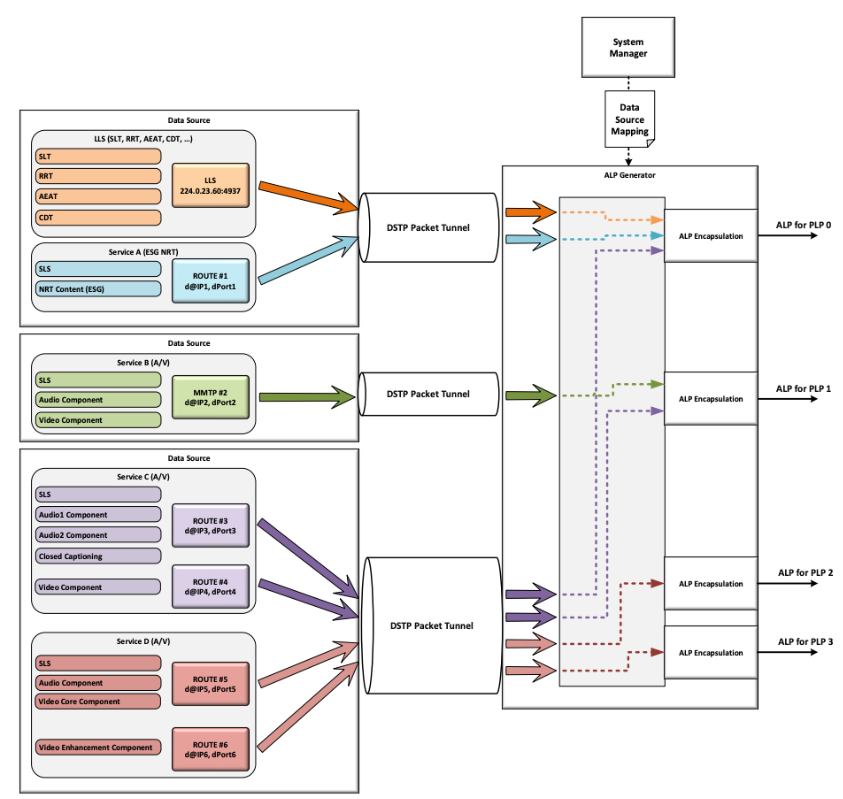
Every Physical Layer frame begins with a Bootstrap and is designed for robust detection under low-signal conditions. As described in ATSC A/321 and A/322, receivers may periodically monitor the Bootstrap while in low-power or standby modes. When a non-zero Emission Wakeup Field is detected, the receiver acquires and processes the associated signaling and alert content carried in subsequent frames.
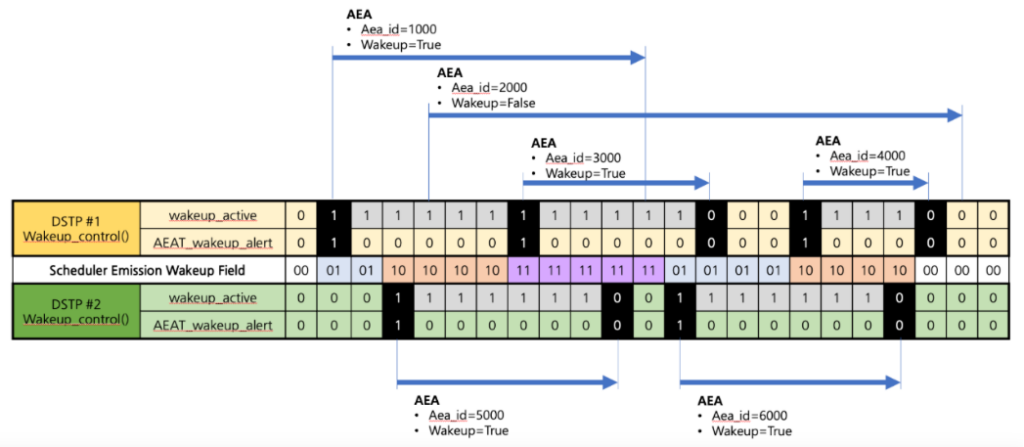
This architecture separates responsibilities across standards layers:
- A/331 (AEAT) – Defines alert metadata and the @wakeup attribute
- A/324 (STL) – Conveys wake-up control signaling to the exciter
- A/322 (Physical Layer) – Carries the Emission Wakeup Field in the Bootstrap
- A/321 (System Discovery and Signaling) – Describes receiver monitoring and acquisition behavior
The Wakeup feature in ATSC 3.0 provides a timely indication of critical alert information through coordinated operation across service-layer signaling (A/331), STL transport control (A/324), and physical-layer signaling (A/322) to function as a complete end-to-end mechanism. By coordinating signaling across system layers, ATSC 3.0 delivers critical alert information in a structured and reliable manner.
Receiver Monitoring and Activation
When the Emission Wakeup Field in the Bootstrap contains a non-zero value (01, 10, or 11), it indicates wake-up signaling is active. Receivers capable of supporting the wake-up feature may operate in a low-power monitoring state in which the Bootstrap is periodically evaluated for changes in the emergency wake-up bit values. A transition to a new non-zero state signifies the presence of a new or updated emergency condition. Upon detection of such a condition, the receiver transitions from monitoring mode to active decoding, proceeds to acquire L1 signaling, identifies the Physical Layer Pipe (PLP) carrying Low Level Signaling (LLS), and locates the Advanced Emergency Alerting Table (AEAT). The receiver then processes the associated alert metadata and related content resources. If the Emission Wakeup Field remains 00, or reflects a previously dismissed state, the receiver continues monitoring without transitioning to active processing. This behavior enables controlled and intentional activation in response to new or updated emergency information signaling.
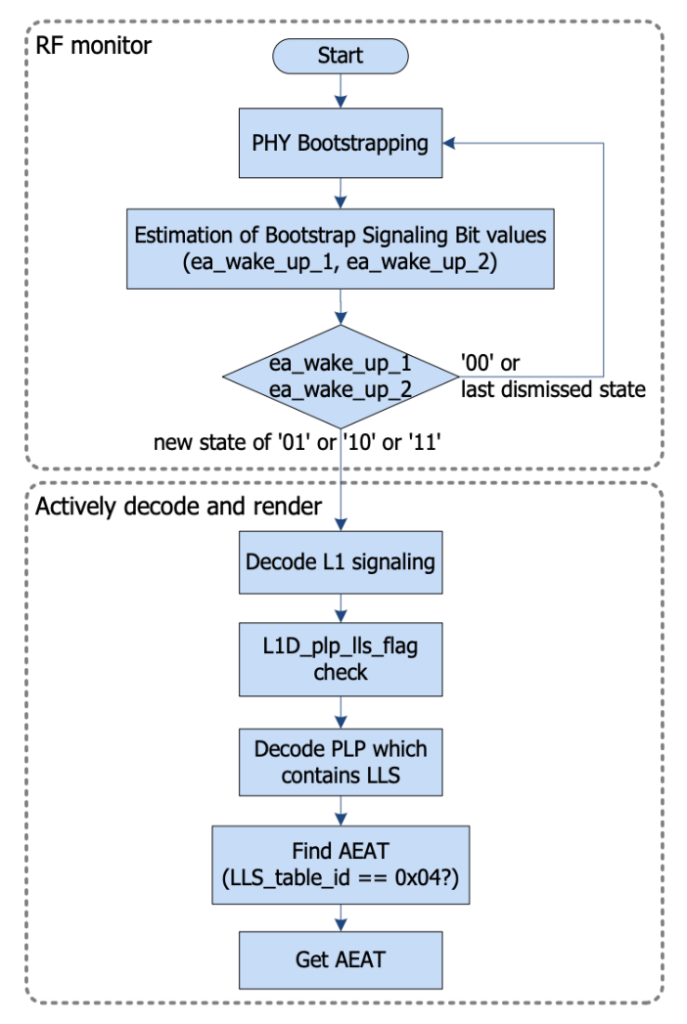
Alert Workflow
The wake-up workflow begins when the AEAT indicates that wake-up signaling is associated with an alert. This signaling is conveyed via STL control mechanisms to the transmitter, which asserts the Bootstrap Emission Wakeup Field at the physical layer. Receivers monitoring the Bootstrap in low-power standby mode detect the asserted wake-up indication and then acquire the associated ATSC 3.0 service to process the alert content.
- Emergency Alert Issuance: Government or authorized emergency management agencies generate an alert, and the AEAT @wakeup attribute is set to true to indicate that wake-up signaling is associated with the alert.
- Bootstrap Wake-Up Indication: The transmission system asserts the Emission Wakeup Field within the Bootstrap, indicating the presence of wake-up signaling related to critical alert content.
- Bootstrap Monitoring: ATSC 3.0 receivers operating in low-power or standby modes periodically monitor the Bootstrap to detect the wake-up indication.
- Receiver Acquisition: Upon detecting a non-zero Emission Wakeup Field, receivers transition from standby mode and acquire the appropriate ATSC 3.0 service carrying the alert signaling.
- AEAT Processing and Presentation: The receiver processes the AEAT metadata and presents the alert content, which may include text, audio, video, graphical elements, and interactive components.
This process ensures that critical information during an emergency is delivered to audiences even when their television or receiver is turned off.
Use Cases
The ATSC 3.0 wake-up feature supports a range of critical public safety and government communication scenarios that require timely and reliable dissemination of emergency information to affected audiences. Use cases include:
- Government-mandated notifications: Federally or state-authorized alerts issued in accordance with regulatory requirements to inform the public of urgent matters affecting public safety or national security.
- Nationwide emergency broadcasts: Presidential or national-level alerts distributed across the entire broadcast footprint to ensure universal reach during large-scale emergencies.
- Severe weather alerts: Notifications related to hurricanes, tornadoes, earthquakes, floods, wildfires, or other natural disasters requiring immediate public awareness and response.
- Geo-targeted local emergency notifications: Alerts directed to specific counties, municipalities, ZIP codes, or defined geographic coordinates to inform only affected populations.
- Evacuation and shelter-in-place orders: Instructions issued during hazardous events such as chemical spills, wildfires, or severe storms to guide public protective actions.
Technical Challenges and Considerations
The implementation of the ATSC 3.0 wake-up feature introduces several technical challenges and operational considerations that must be addressed to ensure reliable and efficient system performance. Key considerations include:
- Receiver compatibility: Devices must incorporate ATSC 3.0-compliant hardware and software capable of monitoring the Bootstrap and interpreting wake-up signaling in accordance with A/321 and A/322 specifications. This includes proper implementation of low-power monitoring behavior and correct handling of the Emission Wakeup Field.
- Power consumption management: Receivers operating in standby or low-power modes must implement efficient Bootstrap monitoring mechanisms to detect wake-up signaling without significantly increasing energy usage. Achieving this balance requires careful design of duty cycles, RF front-end activation timing, and signal acquisition thresholds.
- Broadcaster coordination: Emergency alert signaling must be properly coordinated across broadcast facilities, including alignment between AEAT generation, STL transport signaling, and exciter configuration. Integration with external emergency management systems and alert origination platforms is required to ensure accurate and timely assertion of wake-up signaling.
Conclusion
The Wake-up feature in ATSC 3.0 represents a significant advancement in emergency alerting technology by enabling devices to power on and display alerts, including rich media files such as audio files, video clips, graphical maps, and support for multilingual message content. These features improve public safety and ensure that critical information reaches audiences when it matters most. As ATSC 3.0 deployment continues, broadcasters and manufacturers must collaborate to maximize the adoption and effectiveness of these capabilities.
References
https://www.atsc.org/wp-content/uploads/2025/08/A321-2025-07-System-Discovery-and-Signaling.pdf
https://www.atsc.org/wp-content/uploads/2025/08/A324-2025-07-Scheduler-STL.pdf
https://www.atsc.org/wp-content/uploads/2025/10/A331-2025-10-Signaling-Delivery-Sync-FEC.pdf