
ATSC 3.0: B2X Interworking With 5G Systems for End-to-End Broadcast Integration
Sangsu Kim, Rashmi Kamran, Udaiyappan Palaniyappan, Michael Simon, Guy Meador, Altan Stalker
April 2026
Abstract – Today, broadcast and mobile systems work separately. Broadcast excels at delivering high capacity, one-to-many content, while mobile networks are better at personalized and interactive unicast services. The industry now needs a practical way to combine these strengths under a common Internet Protocol (IP)-based structure.
B2X (Broadcast-to-Everything) is a developing standard in Advanced Television Systems Committee (ATSC) that merges the reach of broadcast with the capabilities of mobile networks. B2X aligns ATSC 3.0 with the Third Generation Partnership Project (3GPP) Fifth Generation (5G) System to connect broadcast delivery with mobile session control, security, and service management. This allows broadcasters and mobile operators to share network resources and offer consistent user experiences across all devices, whether content comes over-the-air or through mobile network broadband.
This paper introduces a framework for integrating ATSC B2X with the 5G System to build a broadcast system that works together with mobile networks. It focuses on radio access network coordination to enable efficient offload of suitable services to the B2X Radio Access Network (RAN), while remaining aligned with 5G Core control and management. At the service layer, service discovery is independent of media delivery, allowing the same service to be discovered through broadcast, broadband, or hybrid signaling, while the actual delivery of service content may be dynamically selected between broadcast and broadband paths. This approach enables unified service listings and shared metadata, supports transparent switching across delivery paths, and shows how multicast and broadcast offload to the B2X RAN can preserve a consistent user experience.
Introduction
In recent years, the need for broadcast/multicast traffic patterns has increased for modern mobile communication ecosystems. For example, video streaming now accounts for a substantial share of mobile network traffic, as highlighted in Ericsson’s report [1]. At the same time, demand for interactive services including multicast traffic patterns is rising due to emerging technologies such as Artificial Intelligence (AI) and immersive communication.
These services cannot be supported solely through traditional one‑way broadcast delivery. Interworking between mobile and broadcast networks allows their distinct advantages to complement each other. Broadcast networks are inherently efficient for large‑scale broadcast and multicast delivery, leveraging mechanisms such as in‑band synchronization. Mobile networks, by contrast, were originally designed around unicast communication, providing two‑way connectivity at both the radio layer and the application layer through Protocol Data Unit (PDU) sessions. By enabling interworking between the two domains, multicast/broadcast traffic can be offloaded to broadcast networks, freeing mobile network resources to serve the load of unicast services without interruption. At the same time, broadcast networks can rely on mobile uplink capabilities to support interactive and personalized service experiences. This combined approach creates a more efficient and capable hybrid communication environment.
The original broadcast and mobile network designs did not account for interworking, so challenges arise across the different network layers when considering it. Effective coordination between the two networks is required. In addition, certain physical‑layer aspects may also need harmonization to ensure consistent operation across both systems. In this context, ATSC B2X (Broadcast‑to‑Everything) is being designed and standardized with interworking as a core design principle, enabling smoother integration between mobile and broadcast networks [2,3,4,5]. It also provides standard IP multicast delivery from external systems to Broadcast Endpoint devices. In addition, the B2X System can utilize unicast 2-way IP routability via the 5G system to interact with end‑user equipment, an important capability for supporting interactive services. The B2X RAN also adopts disaggregated and virtualized RAN principles, enabling more intelligent and flexible RAN management.
Multiple interworking approaches are possible between ATSC B2X and 3GPP 5G systems, each introducing different levels of complexity and shaping the overall B2X system design. This paper provides an overview of these approaches and presents a detailed framework for one radio‑access‑level interworking method that may serve as a viable solution. It also outlines the high‑level requirements that both networks must support to enable RAN‑level interworking. This work builds on established mobile service environments and focuses on significantly improving delivery efficiency by using interworking between ATSC B2X and 3GPP 5G systems. Together, these advances demonstrate one of the possible practical paths toward a globally interoperable broadcast and mobile ecosystem.
In this context, this paper introduces a new architecture initiated by ATSC called B2X. Introduction of the 3GPP 5G system is included next to provide the basics required for interworking framework. An overview of a few other possible solutions is also covered to provide the complete context about possible interworking methods. Further, we show/explore a solution for interworking between the ATSC B2X and the 3GPP 5G systems at the radio access level called the F1 integration method, which, to the best of our knowledge, has not been covered before. This paper also highlights support requirements for both networks.
ATSC B2X System Concepts
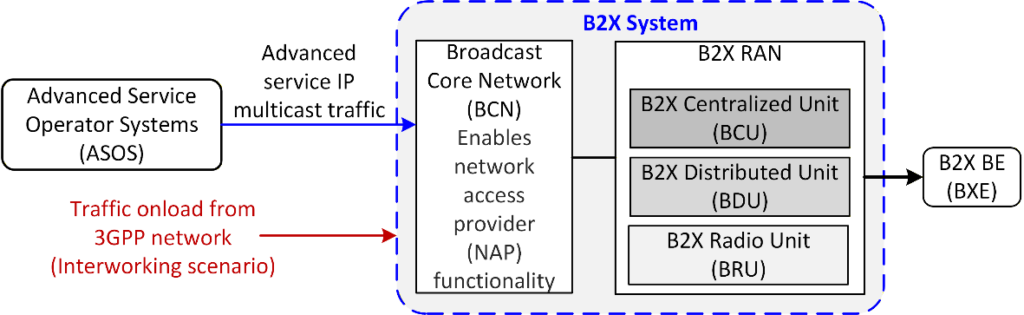
The ATSC B2X system architecture is designed to support interworking with other networks, including generic IP networks and 3GPP systems for 2-way unicast IP reachability with Broadcast Endpoints (BEs). It is designed to aligned with 5G RAN physical layer capabilities, facilitating user-plane convergence above Layer 2, along with the necessary control-plane procedures to enable unified delivery of 5G traffic via the B2X system. Fig. 1 presents a high-level conceptual view of the ATSC B2X system architecture.
The system consists of the Broadcast Core Network (BCN) and the B2X RAN along with Advanced Service Operator Systems (ASOS) and B2X Broadcast Endpoint (BXE). ASOS denotes service platforms that operate outside the B2X system and delivers IP multicast content, and required service‑specific signaling, to BXEs.
A BXE is a logical entity, with no required physical embodiment, that can receive B2X traffic. BXEs may be classified as standalone B2X Broadcast Endpoints or as converged user equipment with integrated 3GPP support, depending on their reception capabilities. BCN routes multicast traffic from ASOS to BXEs through B2X RAN. In addition, the BCN is also the primary point of interaction for ASOS, enabling their IP multicast streams to reach BXEs. Through an interface between ASOS and BCN, an ASOS specifies multicast flows using source‑specific multicast identifiers along with the associated operational parameters.
Traffic handed off via the BCN‑defined interface is delivered to the B2X RAN, where it is converted into the appropriate Layer 1 and Layer 2 signaling. A new set of B2X RAN capabilities are being used to develop ATSC B2X, along with the mechanisms that enable interworking with external networks. The B2X RAN is a disaggregated, O-RAN‑aligned functional partitioning and is composed of several key building blocks, as illustrated in the figure: the B2X Radio Unit (BRU), which implements the lower physical layer; the B2X Distributed Unit (BDU), which includes the upper physical layer and B2X Baseband Processing (BBP); and the BCU, which hosts the B2X Link‑layer processing.
B2X RAN Design Features to Support Integration and Advanced Services
Key features in B2X RAN which are designed from an interworking perspective aligned with 5G system are as follows:
- It is a radio access technology based on Orthogonal Frequency Division Multiple Access (OFDMA).
- It can support multiple channel bandwidths: 5, 6, 7, 8, 10, 12, 14, 15, 18, 20, 21, 24, 30, 40, 50 MHz using multiple Inverse Fast Fourier Transform (IFFT) configurations of 2048, 4096, 8192, 16384.
- For narrow band BXEs, it is designed to support channel bandwidth of 0.384, 0.768, 1.536, 3.072 MHz using IFFT configuration of 128, 256, 512, 1024.
- Subcarrier spacing is considered 3000 Hz which is aligned with 5G numerology.
- It can support the following modulation techniques: BPSK, QPSK, 16QAM, 64QAM, 256 QAM.
- For channel coding, it adapts 5G polar codes for control signaling and Low-Density Parity Check (LDPC) rate matching 5G New Radio (NR) for content data.
- It can support Packet Data Convergence Protocol (PDCP) layer level onloading of packets from 5G system.
In addition to the key features described above, there are several specific features such as support for carrier aggregation, Intelligent Single Frequency Network (SFN) with multicast and broadcast capabilities, frequency diversity, time diversity, SFN spatial diversity, and Virtual Bandwidth Part (VBP) B2X slices. These features are included to consider use case-specific requirements, particularly for Internet of Things (IoT) devices, Reduced Capability (RedCap) devices, positioning services, and Vehicle-to-Everything (V2X) applications.
3GPP 5G System Components
The 3GPP 5G system follows a modular and access-agnostic architecture consisting of the User Equipment (UE), the Radio Access Network (5G RAN), and the Core Network (5G CN). The UE interfaces with the network through the RAN, which is logically separated from the core network, as shown in Fig. 2.
This architectural separation enables the integration of heterogeneous access technologies within a unified system framework. In the 5G RAN, the Centralized Unit (CU) manages network signaling, mobility control, radio resource management, and coordination across cells, while the Distributed Unit (DU) handles real-time radio processing and scheduling. The interface between the two radio access nodes is an Xn interface and between DU and CU is an F1 interface. The Radio Unit (RU) provides an interface to the physical radio environment, performing radio-frequency transmission and reception to convert digital data into wireless signals and vice versa.
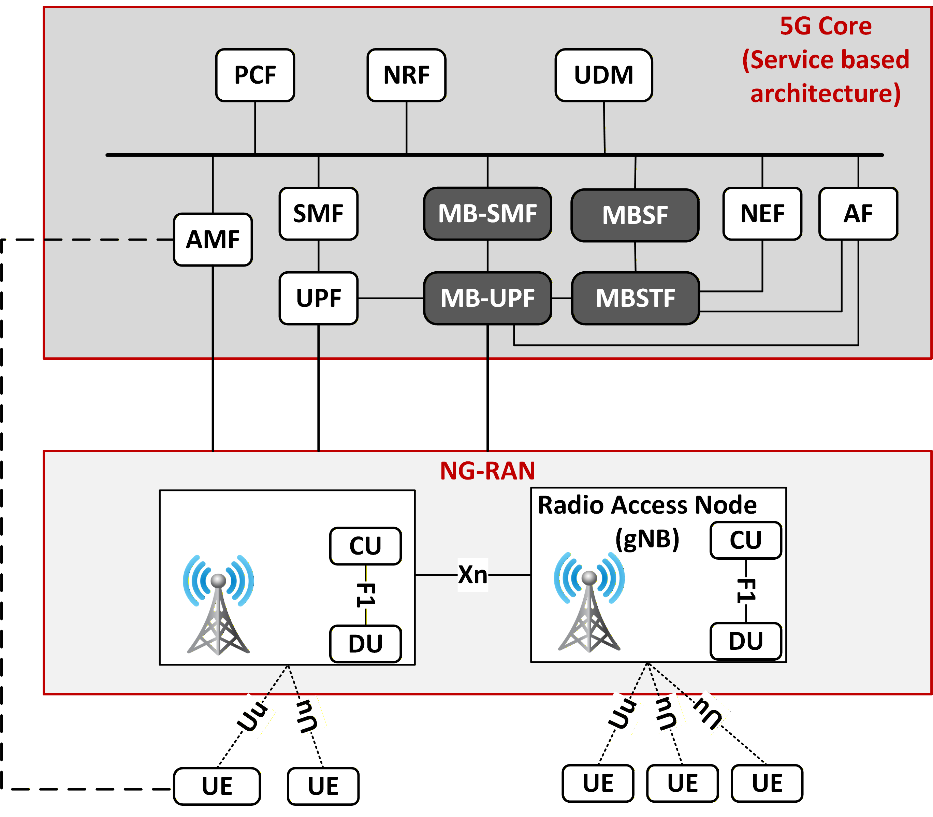
The 5G Core Network is defined using service-based architecture, where network functions expose standardized interfaces to provide services. The core network is responsible for managing access, sessions, and mobility; enforcing security and policies; enabling connectivity to external data networks; and exposing services to external application platforms.
Complementing these functionalities, there are network functions: Session Management Function (SMF) for session and resource control, Policy Control Function (PCF) for policy enforcement, and Network Exposure Function (NEF) for service and API exposure to external application. Building on the flexible RAN and core architecture, 3GPP introduced Multicast/Broadcast Services (MBS) around 2022–2023 adding a multicast and broadcast dimension to the primarily unicast-based 5G delivery framework [6]. MBS enables the simultaneous delivery of content to multiple UEs over a single transmission. In addition to the standard 5G Core functions, specialized components are introduced to deliver MBS Services. Multicast Broadcast-User Plane Function (MB-UPF) handles multicast and broadcast data forwarding to the RAN and UEs, while the MB-Session Management Function (MB-SMF) manages session setup and resource allocation for MBS flows. The MB-Service Function (MB-SF) oversees service-level management, including subscription and authorization, and the MB-Session Transport Function (MB-STF) coordinates the scheduling and distribution of MBS traffic. Together, these components extend the 5G core to enable end-to-end multicast and broadcast delivery alongside traditional unicast services.
Possible Ways of Interworking
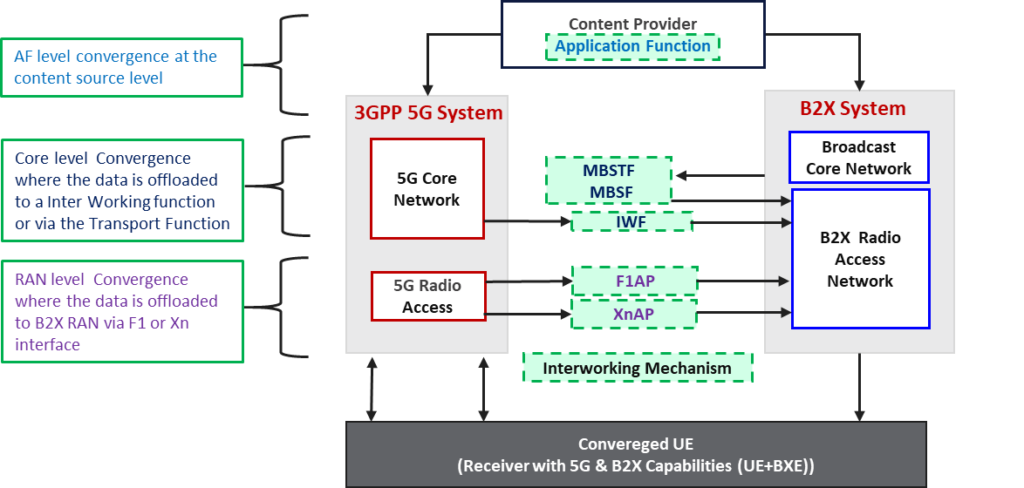
The premise for this interworking is for B2X RAN node to adapt to a multicast and broadcast-based delivery mechanism by developing a 3GPP-based delivery platform that inter-works with 5G networks. For interworking between two networks, a converged UE is required with BXE and UE capabilities to receive data from both the 5G and B2X system. Some interworking options are outlined below (as illustrated in Fig.3)
5G RAN Level Convergence Option
This RAN level convergence option broadly covers the methods of interworking in which data packets can be offloaded from 5G RAN node to B2X RAN node. This option has two sub-options as follows:
- F1 Level integration: In this option, the recommended architecture uses the 5G RAN & core infrastructure and delivers the 5G PDCP data directly to the B2X RAN node over the F1 interface, which will be further delivered over the ATSC B2X Radio to the BXE.
- Dual connectivity using Xn interface: This option recommends a deployment where the 5G RAN and the B2X RAN node are deployed as per the Dual connectivity principles where the 5G RAN node is an anchor node and the B2X RAN node is a secondary node. There are standard mechanisms defined for dual connectivity in 3GPP, but they don’t cover mechanisms for MBS.
5G Core Level Convergence Option
Core-level convergence is when the core user plane participates in offloading data traffic or any core function needs to be modified or defined. The following methods fall under this category:
- Using a new Interworking function (IWF): In line with the non 3GPP offload defined in the 3GPP (for Wi-Fi), this option recommends that the 5G traffic be offloaded to the B2X system via an Interworking function which will interface with the standard 5G CN.
- Using modified MBSF & MBSTF: In this method, Content provider along with MB-STF and MBSF can deliver multicast/broadcast data either through MB-UPF (3GPP network) or ATSC-B2X network.
AF level Convergence Option
For this option, a new application function can be introduced to determine the appropriate delivery path (i.e., via 3GPP Network or Via B2X) for content received from the content provider [7].
The above options are a sampling of all possible interwork approaches. Considering B2X RAN design is in alignment with 5G RAN lower‑layer principles, F1‑level integration emerges as a first method to investigate for interworking. The following section describes some F1‑based integration approaches, including the associated procedural details.
F1 Level Integration Framework
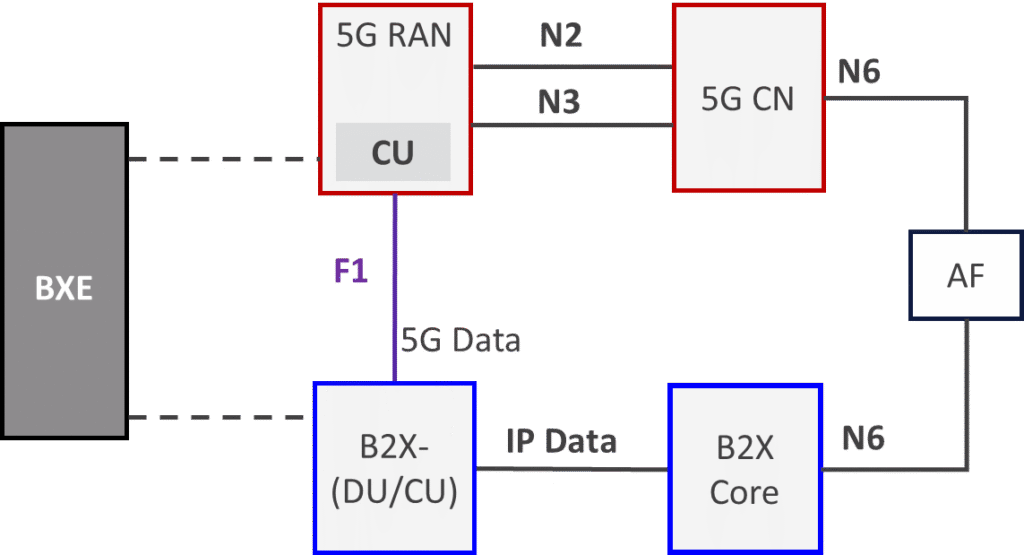
As shown in Fig. 4, the integration framework based on this method aims at using the 5G RAN & Core infrastructure and delivering the 5G PDCP data to the B2X-RAN (DU/CU) over the F1 interface (F1AP), which will be further delivered over the ATSC B2X Radio to the BXE (the consumer of the broadcast multicast data stream). The F1 interface, defined by 3GPP [8], specifies the interface between the 5G RAN CU and the 5G RAN DU and provides a well-defined separation between control-plane (F1-C) and user-plane (F1-U) functions.
Interworking Procedures/Methods
This section describes the proposed interworking procedures between the 3GPP 5G system and the B2X RAN, focusing on integration at the F1 interface between the Centralized Unit (CU) and the Distributed Unit (DU). The procedures define how services are announced, discovered, managed, and delivered when traffic offload from broadband to B2X broadcast is enabled. The scope of this section assumes that 5G core functions such as the Access and Mobility Management Function (AMF), SMF, and AF are already present and operational, as described in the preceding system architecture sections and system level coordination exists between 5G 3GPP system and B2X system [9]. The procedures below explain how these functions interact with the B2X RAN through F1-level coordination, while keeping service discovery logically separated from delivery decisions.
Network Registration
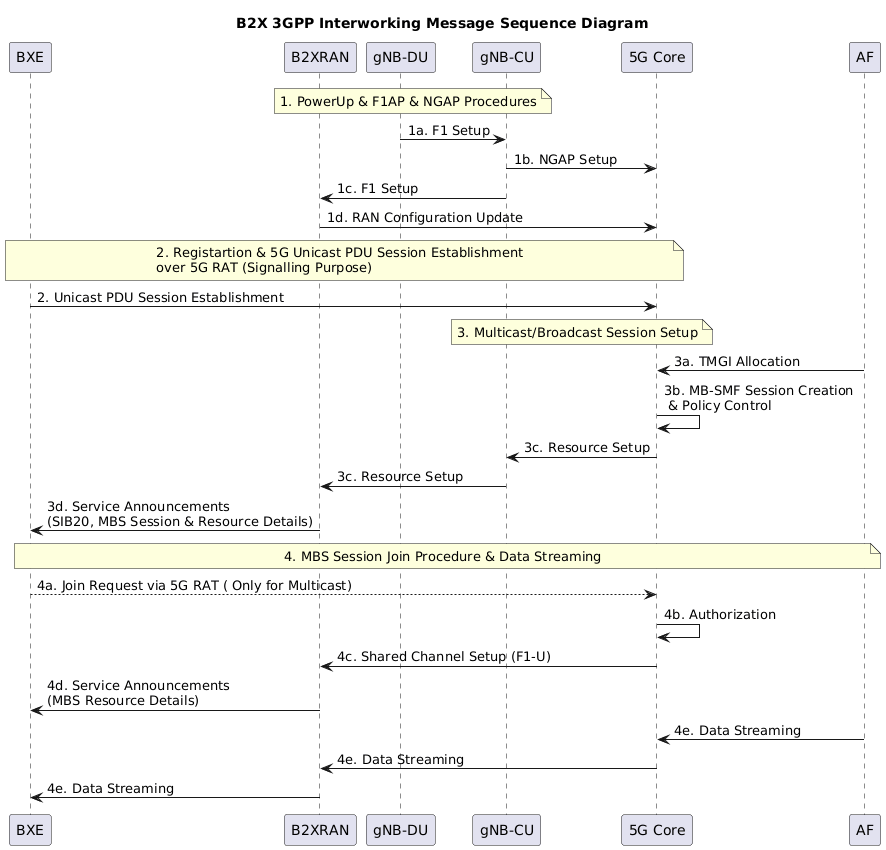
As part of the power-on procedures the control path (F1 Application Protocol (F1AP) & NG Application Protocol (NGAP)) between the gNB, B2X-RAN components and the 5GCN gets established (Fig. 5, Step 1). The BXE registers with the converged architecture via the 5G registration procedures. During this process, the B2X-RAN will establish connectivity with the 5G components over the F1-Based interface. It is a proposed design, and it is also intended to set up a unicast session between the 5G network and the BXE thus enabling IP connectivity between the BXE & BAPS (Fig. 5, Step 2).
Policy Configuration
Policy configuration defines the conditions under which a service may be delivered using multicast or broadcast through the B2X RAN. BCN and 5G Core networks will require service level interactions to pre-configure rules for the dynamic policies in PCF. Based on these dynamic policies, PCF provides decision rules that guide, how the services should be delivered when offload is considered. These inputs may include service priority, QoS, delivery preference, coverage requirements, or indications that a service is suitable for multicast or broadcast offload. The PCF evaluates this information to determine whether multicast or broadcast delivery is permitted or preferred for a given service for the given subscriber.
The outcome of policy evaluation is communicated to the MB-SMF as policy guidance during the session establishment (Fig.5, Step-3b). Based on this guidance, the MB-SMF applies the appropriate delivery behavior when establishing or updating sessions, such as enabling multicast delivery or selecting a B2X broadcast-capable path. Policy configuration therefore influences how a service is delivered, but not which service is discovered or selected by the application.
Session Management
The 5G MBS session establishment procedures for multicast and broadcast will allow the B2X-RAN to receive the IP stream via the 5G RAN over the F1 interface. Session management in the proposed F1-based B2X interworking framework defines how a discoverable service is instantiated as an active multicast or broadcast. Multicast and broadcast sessions are controlled using dedicated 3GPP multicast/broadcast functions and are managed independently of traditional unicast PDU sessions.
Sessions are initiated through the Application Function (AF), which interacts with the 5G core via the NEF (Fig. 5, Step 3). Session lifecycle control is primarily handled by the MB-SMF, reflecting the distinct control requirements of multicast and broadcast services. During session establishment, the MB-SMF allocates and binds a multicast/broadcast identifier, such as a Temporary Mobile Group Identity (TMGI) (Fig. 5, Step 3a), to the service. Policy and authorization checks are applied through coordination among the AF, NEF, PCF, and MB-SMF to determine whether the service may be activated and under what delivery constraints (Fig. 5, Step 3b).
Once authorized, the MB-SMF configures the user-plane delivery path by setting up forwarding through the MB-UPF. Service traffic is then mapped through the CU user-plane functions and delivered to the B2X RAN via the F1-U interface (Fig.5, Step 3c). This mapping enables multicast or broadcast delivery within the B2X RAN while maintaining consistency with 5G core session control.
Service Announcement and System Discovery
Service announcement and discovery in B2X are designed to operate across converged architecture supporting multicast and broadcast delivery (Fig 5, Step 3d). A key aspect of the design is that 3GPP-specific service signaling is not exposed directly to the B2X side. Instead, service information is interpreted at the interworking boundary and represented in a form suitable for B2X service discovery.
Service Information at the 3GPP–B2X Boundary
In the 3GPP system, multicast and broadcast services are identified using system-level service broadcast signaling, including traffic channel information, identifiers such as TMGI, service type and associated service parameters. This information is meaningful within the 3GPP radio and core network context. In the proposed interworking framework, this service information is consumed by the network at the boundary between the 5G system and the B2X RAN, rather than being forwarded unchanged (Fig. 5, Step 3d). The B2X CU derives the service identity and availability information needed for multicast and broadcast operation and maps it into B2X-specific service signaling that aligns with the B2X CU/DU architecture and ATSC B2X service concepts. This approach preserves the meaning of the 3GPP service announcement while avoiding direct dependency on 3GPP signaling formats within the B2X RAN.
Service Discovery in the B2X Domain
Once service information is represented in the B2X domain, B2X supports two complementary service discovery paths. The first is a broadcast-oriented discovery path, consistent with ATSC service announcement principles, such as Service List Table (SLT)-style service listings. This method supports one-way service discovery for multicast and broadcast delivery and does not require IP connectivity. The second is an IP-based discovery path intended for environments where broadband connectivity is available. In this case, a list of services and related metadata are exposed using IP-based formats that are suitable for mobile applications. These IP representations are different from both 3GPP signaling and broadcast signaling formats, but they reference the same logical services.
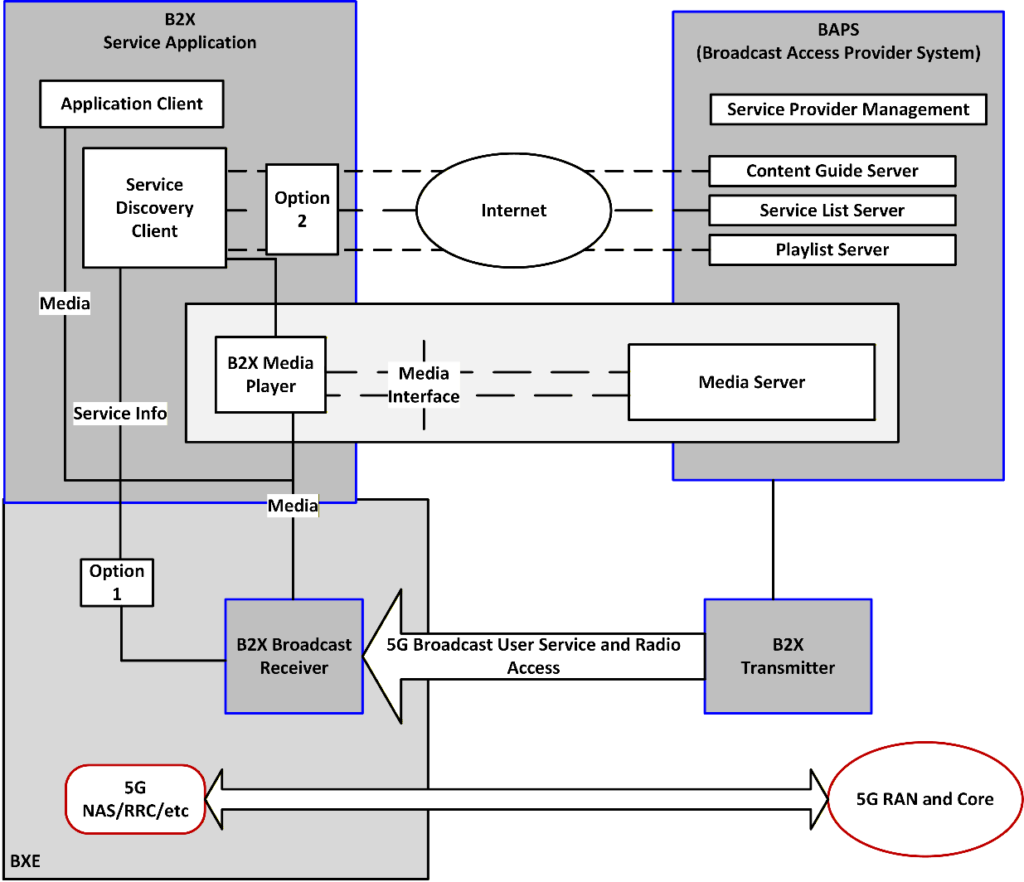
Figure 6 illustrates the B2X service access model and two discovery options that lead to the same outcome: a user selects a service first, and the delivery path is chosen afterward.
- Option 1 – ATSC 3.0 SLT style broadcast discovery: Service information (for example, SLT- Service List Table signaling) is obtained one-way via the B2X receiver. After the service is selected, media delivery is started on the B2X broadcast or multicast path.
- Option 2 – DVB-I (Internet)-like hybrid discovery: Equivalent service list, content guide, and playlist information is obtained over the Internet from BAPS servers (functionally similar to a DVB-I style service discovery approach). After the service is selected, media delivery can be directed to either the B2X path or broadband, depending on availability and offload control under the 5G system.
Separation of Discovery from Delivery
The network decides whether delivery uses multicast, broadcast, or broadband based on content-based policies and operator-defined charging strategies. Service discoveries via service announcements will list the services that are available in the B2X domain, which allows the BXE to select the services. This separation allows B2X to support efficient offload while keeping service discovery consistent and stable across different environments.
Delivery
With converged UE registered into the 5G network, MBS session established, and service announcements made in the B2X domain, the BXE can now join a multicast session or tune in to a broadcast session (Fig. 5 Step-4).
For Multicast delivery, the join procedure initiated by the BXE will configure the resources in B2X-RAN and stream the content originating at the AF via the MB-UPF, through the gNode B (gNB)-RAN and then redirected to the B2X-RAN DU (BDU) over F1 interface before being scheduled and transmitted over the B2X radio to reach the BXE (Fig. 5 Step 4e).
When the Broadcast session is set up at the 5GCN the service announcements and signaling procedure involved will ensure the B2X-RAN discovers the availability of broadcast sessions via the F1 interface. The B2X-RAN configures the necessary radio resources and shall start transmitting the stream over the air to the BXE. The BXE, now being aware of the multicast or broadcast stream availability made known via service announcements, will tune into the respective channel to start receiving the data stream.
Synchronization
In a converged ATSC-B2X+5G architecture, synchronization is important for timing-sensitive 5G operations such as slot-level coordination and feedback. However, in case of interworking with independent non 5G RATs or non-3GPP nodes, B2X interfacing over F1 can function without the same strict timing requirements.
Design/Support Requirements
Based on the proposed RAN-level coordination method, this section summarizes the design and support requirements for B2X-5G interworking to enable policy-governed offload to B2X multicast or broadcast resources under 5G Core session and security control.
B2X Design Requirements
- Support for F1AP handler is included in the B2X-RAN design to handle the F1AP interface.
- A service announcement procedure is incorporated to receive required information from the 5G-RAN and to convey the MBS-related session information to the BXE.
- Downlink data delivery support is included to schedule and forward downlink multicast and broadcast traffic received over F1-U toward the B2X radio interface.
- Regarding operation and management, the design includes mechanisms for configuration, monitoring, Key Performance Indicator (KPI) reporting, and fault management for Downlink-only and MBS operation.
3GPP 5G System Support Requirements
- Architecture-related updates are expected to reflect a B2X-RAN (Non-3GPP RAN) in the F1-based integration model.
- F1AP specification updates are expected to cover required signaling and management aspects to enable the F1 interface with B2X-RAN.
- UE Capability procedures are expected to include B2X UE Capabilities information toward converged network via the 5G RAT.
- System Information Block (SIB) related updates are expected so that B2X-RAN can support the service announcement procedure.
- Updates to 5GCN specification are expected to allow MBS session over Non-3GPP RAN.
Overall, these design/support requirements show that the proposed coordination approach is implementable with a clear split between (i) B2X-side functions that enable broadcast delivery under RAN coordination and (ii) 3GPP-side alignment points that preserve 5G Core governance. This framing also helps identifying concrete areas for future 3GPP contributions while keeping the solution practical.
Usage Scenarios and Benefits of Interworking
Interworking between diverse types of networks consistently creates opportunities such as optimizing spectrum usage, extending service reach and specifications, and ensuring seamless performance for end users [10].
There are several usage scenarios that highlight the importance of interworking between broadcast and mobile networks. The following sections explore these interworking usage scenarios and outline the potential benefits they can deliver.
Towards the global goal of ubiquitous connectivity: Interworking between ATSC B2X and 3GPP 5G systems can provide basic connectivity in unconnected areas. It significantly enhances wide‑area coverage by leveraging the large‑cell capabilities of B2X broadcast systems. Ubiquitous connectivity is a shared objective across all major wireless and wired communication SDOs, as it directly influences efforts to reduce the digital divide in developing countries where coverage gaps remain substantial.
Advanced services support: Interworking between two networks can help serve advanced services without affecting basic services. Network traffic associated with shared environments can be multicast across the B2X network, and network traffic associated with device specific updates can be unicast across the Mobile network. Conclusion
AI model distribution: AI‑driven optimization is becoming integral across all levels of modern mobile networks. As AI models are deployed and executed at the core, in RAN, and even in user equipment, their training and inference workflows require substantial data exchange. An interworking solution can be leveraged to offload portions of this data transfer onto broadcast, thereby reducing the AI‑related signaling and traffic burden on mobile networks. This paper described an ATSC 3.0-B2X interworking framework for coordinated operation with the 5G system, with a focus on RAN-level support for multicast and broadcast offload. The approach enables the 5G system to direct suitable AI related model distribution to B2X RAN resources when they are available, while keeping service control consistent with 5G Core functions.
High Traffic congestion events: During large‑scale events with exceptionally high audience density, mobile networks can become overloaded by simultaneous unicast and multicast/broadcast traffic, leading to service degradation. In such scenarios, interworking with broadcast networks enables seamless service continuity by offloading multicast traffic to the B2X system, thereby resolving the congestion issue on the mobile network. This coordination is important because today’s mobile delivery model does not scale well for widely shared content. Delivering the same program repeatedly over unicast consumes radio resources and increases network cost. Offloading those services to multicast or broadcast via the B2X RAN improves spectrum use and helps maintain consistent service quality as demand grows.
Emergency services: With interworking, emergency alert signaling can be carried on B2X broadcasting without increasing unicast traffic on mobile networks in emergency scenarios.
Importantly, the proposed framework is an implementable architecture rather than a conceptual design. It is grounded in existing 5G system functions and interfaces and identifies concrete integration points that can be realized using current network components and procedures. As a result, the proposed framework can be used as a practical baseline for prototyping and interoperability work, and it provides a clear technical foundation for future contributions and alignment discussions within 3GPP.
Potential Benefits of Interworking
To efficiently address the growing demand for content consumption, interworking between B2X and 5G systems can result in the following benefits:
- Effective spectrum utilization can be improved by coordinating RAN physical‑layer resources across multiple frequency bands.
- Availability of broadcast resources through interworking between two networks can reduce the total resource consumption in the mobile network, thereby enhancing overall network scalability.
- Cellular network congestion can be mitigated by offloading multicast/broadcast traffic to the broadcast network.
- Interworking enables seamless service continuity across heterogeneous access infrastructures.
- Coordinated control, data delivery, and service management across cellular and broadcast domains can enhance user experience and support emerging hybrid broadcast–broadband service models.
Conclusion
This paper described an ATSC 3.0-B2X interworking framework for coordinated operation with the 5G system, with a focus on RAN-level support for multicast and broadcast offload. The approach enables the 5G system to direct suitable services to B2X RAN resources when they are available, while keeping service control consistent with 5G Core functions such as session management, policy control, and security.
This coordination is important because today’s mobile delivery model does not scale well for widely shared content. Delivering the same program repeatedly over unicast consumes radio resources and increases network cost. Offloading those services to multicast or broadcast via the B2X RAN improves spectrum use and helps maintain consistent service quality as demand grows. The framework applies delivery path selection after a service is selected, so applications can keep the same service experience while the network chooses the most efficient delivery path.
Importantly, this is an implementable architecture rather than a conceptual design. It is grounded in existing 5G system functions and interfaces and identifies concrete integration points that can be realized using current network components and procedures. As a result, the proposed framework can be used as a practical baseline for prototyping and interoperability work, and it provides a clear technical foundation for future contributions and alignment discussions within 3GPP.
References
- Ericsson, “Ericsson Mobility Report,” November 2025. Online available
- IBC R16 07-28-2025, “ATSC (B2X) Multicast Broadcast Neutral-Host O-RAN System Architecture”.
- BEIT-Conference-Proceedings 2024, “The convergence opportunity for ATSC 3.0 and 5G-NR Multicast Broadcast service”.
- %5b4%5dhttps:/members.atsc.org/wg/s44/document/60147
- S44-2-A392-21r0-Working-Draft-B2X-System-Discovery-and-Signaling.pdf
- 3GPP TS 23.247 (2025), Architecture and functional description for multicast-broadcast services (MBS).
- TR 6026, “5G Extensions for Broadcast Offload,” TSDSI Technical Report, March 2024. Available at https://www.ee.iitb.ac.in/~infonet/TSDSI-TR-6026-V1.0.0.pdf
- 3GPP TS 38.473 V18.6.0 (2025-06) NG-RAN F1 application protocol (F1AP)
- 3GPP TS 23.247 (2025), Architecture and functional description for multicast-broadcast services (MBS).
- R. Kamran et al., “Convergence of 6G and ATSC3 Networks via Broadcast to Everything (B2X): Use cases, Solutions and Collaborations,” 2025 IEEE Future Networks World Forum (FNWF), Bangalore, India, 2025, pp. 1-6, doi: 10.1109/FNWF66845.2025.11317205.
Abbreviations
| 3GPP | Third Generation Partnership Project |
| 5G | Fifth Generation |
| 6G | Sixth Generation |
| AI | Artificial Intelligence |
| AF | Application Function |
| AMF | Access and Mobility Management Function |
| ASOS | Advanced Service Operator Systems |
| ATSC | Advanced Television Systems Committee |
| B2X | Broadcast-to-Everything |
| BCN | Broadcast Core Network |
| BBP | B2X Baseband Processing |
| BDL | Broadcast Downstream Links |
| BDU | B2X Distributed Unit |
| BE | Broadcast End points |
| BER | Bit Error Rate |
| BLP | B2X Link-layer Protocol |
| BRU | B2X Radio Unit |
| BXE | B2X Broadcast Endpoint |
| DU | Distributed Unit |
| CN | Core Network |
| CU | Centralized Unit |
| DVB | Digital Video Broadcasting |
| F1AP | F1 Application Protocol |
| gNB | gNode B |
| IFFT | Inverse Fast Fourier Transform |
| IMT | International Mobile Telecommunications |
| ITU | International Telecommunication Union |
| IoT | Internet of Things |
| IP | Internet Protocol |
| IWF | Interworking function |
| KPI | Key Performance Indicator |
| LDPC | Low Density Parity Check |
| LTE | Long Term Evolution LTE |
| MBS | Multicast Broadcast Services |
| MBSF | Multicast/Broadcast Service Function. |
| MBSTF | Multicast/Broadcast Service Transport Function |
| MB-SMF | Multicast/Broadcast Session Management Function |
| MB-UPF | Multicast/Broadcast User Plane Function |
| N5CN3 | Non-5G Capable over Non-3GPP |
| NAP | Network Access Provider |
| NAS | Non-Access Stratum |
| NEF | Network Exposure Function |
| NGAP | NG Application Protocol |
| NR | New Radio |
| OFDMA | Orthogonal Frequency Division Multiple Access |
| PCF | Policy Control Function |
| PDCP | Packet Data Convergence Protocol |
| PDU | Protocol Data Unit |
| QoS | Quality of Service |
| RAN | Radio Access Network |
| RedCap | Reduced Capability |
| RU | Radio Unit |
| RS | Resource Scheduling |
| SDO | Standard Development Organization |
| SFN | Single Frequency Network |
| SIB | System Information Block |
| SLT | Service List Table |
| SMF | Session Management Function |
| UE | User Equipment |
| V2X | Vehicle-to-everything |
| VBP | Virtual Bandwidth Part |
| WLAN | Wireless Local Area Network |